Summary Applied Corporate Finance –
Aswarth Damodaran (4th edition)
Chapter 1: The foundations
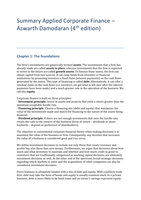
The firm’s investments are generically termed assets. The investments that a firm has
already made are called assets in place, whereas investments that the firm is expected
to invest in the future are called growth assets. To finance these assets, the firm can
obtain capital from two sources. It can raise funds from investors or financial
institutions by promising investors a fixed claim (interest payments) on the cash flows
generated by the assets. This type of financing is called debt. Alternatively, it can offer a
residual claim on the cash flows (i.e. investors can get what is left over after the interest
payments have been made) and a much greater role in the operation of the business. We
call this equity.
Corporate finance is built on three principles:
- Investment principle. Invest in assets and projects that yield a return greater than the
minimum acceptable hurdle rate.
- Financing principle. Choose a financing mix (debt and equity) that maximizes the
value of the investments made and match the financing to the nature of the assets being
financed.
- Dividend principle. If there are not enough investments that earn the hurdle rate,
return the cash to the owners of the business (form of return – dividends or share
buybacks – depend on preference of shareholders).
The objective in conventional corporate financial theory when making decisions is to
maximize the value of the business or firm. Consequently, any decision that increases
the value of a business is considered good and vice versa.
We define investment decisions to include not only those that create revenues and
profits buy also those that save money. Furthermore, we argue that decisions about how
much and what inventory to maintain and whether and how much credit to grant to
customers that are traditionally categorized as working capital decisions are ultimately
investment decisions as well. At the other end of the spectrum, broad strategic decisions
regarding which markets to enter and the acquisitions of other companies can also be
considered investment decisions.
Every business is ultimately funded with a mix of debt and equity. With a publicly trade
firm, debt may take the form of bonds and equity is usually common stock. In a private
business, debt is more likely to be bank loans and an owner’s savings represent equity.
Aswarth Damodaran (4th edition)
Chapter 1: The foundations
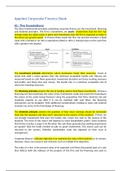
The firm’s investments are generically termed assets. The investments that a firm has
already made are called assets in place, whereas investments that the firm is expected
to invest in the future are called growth assets. To finance these assets, the firm can
obtain capital from two sources. It can raise funds from investors or financial
institutions by promising investors a fixed claim (interest payments) on the cash flows
generated by the assets. This type of financing is called debt. Alternatively, it can offer a
residual claim on the cash flows (i.e. investors can get what is left over after the interest
payments have been made) and a much greater role in the operation of the business. We
call this equity.
Corporate finance is built on three principles:
- Investment principle. Invest in assets and projects that yield a return greater than the
minimum acceptable hurdle rate.
- Financing principle. Choose a financing mix (debt and equity) that maximizes the
value of the investments made and match the financing to the nature of the assets being
financed.
- Dividend principle. If there are not enough investments that earn the hurdle rate,
return the cash to the owners of the business (form of return – dividends or share
buybacks – depend on preference of shareholders).
The objective in conventional corporate financial theory when making decisions is to
maximize the value of the business or firm. Consequently, any decision that increases
the value of a business is considered good and vice versa.
We define investment decisions to include not only those that create revenues and
profits buy also those that save money. Furthermore, we argue that decisions about how
much and what inventory to maintain and whether and how much credit to grant to
customers that are traditionally categorized as working capital decisions are ultimately
investment decisions as well. At the other end of the spectrum, broad strategic decisions
regarding which markets to enter and the acquisitions of other companies can also be
considered investment decisions.
Every business is ultimately funded with a mix of debt and equity. With a publicly trade
firm, debt may take the form of bonds and equity is usually common stock. In a private
business, debt is more likely to be bank loans and an owner’s savings represent equity.