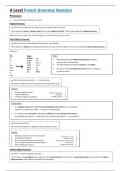
A Level French Grammar Revision
Pronouns:
• A word standing in the place of a noun.
Subject Pronouns:
eg. Pierre va au cinéma. Ses amis sont là aussi. Sa mère reste à la maison.
These words are nouns or proper nouns that are also subjects of verbs. They can be replaced by subject pronouns.
These are; je, tu, il, elle, nous, vous, ils, elles (I, you, he, she, we, you, they, they).
Direct Object Pronouns:
eg. Kamran lit le livre. Eddie écoute de la musique. Il aime Marie.
These words are objects, the things that the verbs are done to by the subject. They can be replaced by direct object pronouns.
These are:
SPs: DOPs: Rules:
Je me (m’) me
Tu • DOPs follow the verb without a preposition in English,
te (t’) you
Il le (l’) him, it eg. She took it. We saw them.
Elle la (l’) her, it • The DOP replaces the object by gender and number.
Nous nous us
vous you • In French, the DOP precedes the verb which it is related to,
Vous
les them eg. Elle les invite.
Ils
Elles
eg. Pierre comprend la question → Il la comprend.
Here both a subject and a direct object pronoun have been used.
Practice:
1. Quentin appelle son ami. L’infirmier les soigne. 3.
2. Il prend la décision. Il la prend. 2.
Quentin l’appelle. 1.
3. L’infirmier soigne ses patients.
Further Rules:
• In a negative sentence the DOP comes directly before the verb which it is related to,
eg. Nous n’acceptons pas l’offre → Nous ne l’acceptons pas.
• In a sentence with two verbs, including an infinitive, the DOP precedes the second,
eg. Il doit finir son article → Il doit le finir. Je vais lire les documents → Je vais les lire.
eg. Je ne vais pas le finir.
Here a DOP is included in a negative sentence, with two verbs.
Practice:
1. Elle peut conduire la voiture de son père. Elle ne l’étudie pas. 5.
2. Il accepte les résultats. Tu vas le visiter. 4.
3. Nous ne comprenons pas leur décision. Nous ne la comprenons pas. 3.
4. Tu vas visiter le château de Fontainebleau. Il les accepte. 2.
Elle peut la conduire. 1.
5. Elle n’étudie pas sa leçon.
Indirect Object Pronouns:
eg. Julien a envoyé un paquet à son père.
This sentence has two objects, one having the action done directly to it, the other is receiving the action. The second is an indirect
object pronoun, often linked to the verb by à, meaning to.
Pronouns:
• A word standing in the place of a noun.
Subject Pronouns:
eg. Pierre va au cinéma. Ses amis sont là aussi. Sa mère reste à la maison.
These words are nouns or proper nouns that are also subjects of verbs. They can be replaced by subject pronouns.
These are; je, tu, il, elle, nous, vous, ils, elles (I, you, he, she, we, you, they, they).
Direct Object Pronouns:
eg. Kamran lit le livre. Eddie écoute de la musique. Il aime Marie.
These words are objects, the things that the verbs are done to by the subject. They can be replaced by direct object pronouns.
These are:
SPs: DOPs: Rules:
Je me (m’) me
Tu • DOPs follow the verb without a preposition in English,
te (t’) you
Il le (l’) him, it eg. She took it. We saw them.
Elle la (l’) her, it • The DOP replaces the object by gender and number.
Nous nous us
vous you • In French, the DOP precedes the verb which it is related to,
Vous
les them eg. Elle les invite.
Ils
Elles
eg. Pierre comprend la question → Il la comprend.
Here both a subject and a direct object pronoun have been used.
Practice:
1. Quentin appelle son ami. L’infirmier les soigne. 3.
2. Il prend la décision. Il la prend. 2.
Quentin l’appelle. 1.
3. L’infirmier soigne ses patients.
Further Rules:
• In a negative sentence the DOP comes directly before the verb which it is related to,
eg. Nous n’acceptons pas l’offre → Nous ne l’acceptons pas.
• In a sentence with two verbs, including an infinitive, the DOP precedes the second,
eg. Il doit finir son article → Il doit le finir. Je vais lire les documents → Je vais les lire.
eg. Je ne vais pas le finir.
Here a DOP is included in a negative sentence, with two verbs.
Practice:
1. Elle peut conduire la voiture de son père. Elle ne l’étudie pas. 5.
2. Il accepte les résultats. Tu vas le visiter. 4.
3. Nous ne comprenons pas leur décision. Nous ne la comprenons pas. 3.
4. Tu vas visiter le château de Fontainebleau. Il les accepte. 2.
Elle peut la conduire. 1.
5. Elle n’étudie pas sa leçon.
Indirect Object Pronouns:
eg. Julien a envoyé un paquet à son père.
This sentence has two objects, one having the action done directly to it, the other is receiving the action. The second is an indirect
object pronoun, often linked to the verb by à, meaning to.