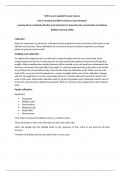
BTEC Level 3 Applied/Forensic Science
Unit 2: Practical Scientific Procedures and Techniques
Learning Aim A: Undertake titration and colorimetry to determine the concentration of solutions
Matthew Howard (9360)
Calibration
Before an experiment is carried out, calibrations of the equipment need to be done so the results can be
effective and accurate. These calibrations are carried out because overtime equipment can change
which can give inaccurate results.
Weighing scale calibration
To calibrate the weighing scale, you will need a range of weights that are exact and tested, these
weights need to be kept in an enclosed place to stop contaminants getting on them and affecting the
weights. When handling these weights tweezers will be needed so you can avoid any contaminants like
dirt from your hands, this could affect the weight. To start the experiment the scale needs to be turned
on and placed on a level stable surface, then put the scale into calibration mode. Make sure the scale
reads 0.00 so you can start the experiment, a range of weights will be used in this calibration. Starting
with the 1g weight place it on the scale (using tweezers), it should read exactly 1g but if it doesn’t the
scale is inaccurate. Repeat this calibration with 2g, 5g and 10g weights and it should all read the same, if
it does the scale has been calibrated successfully. When it is done put the weights back in the enclosed
place.
Pipette Calibration:
Equipment:
25g pipette
Distilled water
Clean beakers
Weighing scale
Pipette filler
Thermometer
-First make sure that the weighing scale is on a stable surface.
-Place the beaker on the scale and make sure the scale reads 0.00.
-Place the pipette into the distilled water to the maximum of 25g, check at eye level for the best
accuracy.
-Transfer the distilled into the dry beaker that is on the scale.
, -The reading on the scale should be 25g which is the same as the pipette. When I did my experiment,
our reading was 24.97g which is a very close value. This shows that the pipette that we were using was
accurate and that the calibration was successful
pH meter calibration:
A pH calibration is the process of adjusting your pH meter by measuring solutions of a known pH value.
This is because the characteristics of your electrode will change over time and this needs to be
compensated for. The Calibration does this by matching your pH meter to the current characteristics of
your pH sensor. First turn on the pH meter and take the electrode out of this storage solution and rinse
it with distilled water, once rinsed dry the electrode. Next the buffers need to be prepared, the first
buffer will be neutral with a pH of 7 and the second should be near the expected sample pH of 9. A
beaker of distilled water is also needed. Place the electrode in the buffer of 7pH and it should read the
same on the pH meter, if it isn't the same the pH meter is not calibrated. Rinse the electrode in the
distilled water to clean it and repeat the process in the buffer at 9pH. If the results are at or close to the
pH of 7 and 9 then the pH meter is calibrated.
Making a standard solution
Introduction
A standard solution is a solution of a precisely known concentration, it is made by dissolving an
accurately weighed mass of a solid in a known volume of solvent using a volumetric flask. This standard
solution allows for you to fun the solutions used in a qualitative practical. This solution will be used for
another experiment which is titration.
Equipment
Funnel
Beaker
Weighing boat
Volumetric flask
Weighing scale
Spatula
Sodium carbonate
Distilled water
Risk assessment
Hazard Risk Control
Sodium carbonate Can cause serious eye irritation and it Wear eye protection and avoid
can be harmful if it is inhaled. contact.
Don’t breathe in.
Glassware The glass can smash which can cause No fast movements and try to handle
cuts. quickly.
Clean up immediately.
Weighing scale Electrical shock Do not touch exposed conductors.
Liquid spills Can cause someone to fall over and get Clean up spills immediately to reduce
hurt. risk of falling.
Unit 2: Practical Scientific Procedures and Techniques
Learning Aim A: Undertake titration and colorimetry to determine the concentration of solutions
Matthew Howard (9360)
Calibration
Before an experiment is carried out, calibrations of the equipment need to be done so the results can be
effective and accurate. These calibrations are carried out because overtime equipment can change
which can give inaccurate results.
Weighing scale calibration
To calibrate the weighing scale, you will need a range of weights that are exact and tested, these
weights need to be kept in an enclosed place to stop contaminants getting on them and affecting the
weights. When handling these weights tweezers will be needed so you can avoid any contaminants like
dirt from your hands, this could affect the weight. To start the experiment the scale needs to be turned
on and placed on a level stable surface, then put the scale into calibration mode. Make sure the scale
reads 0.00 so you can start the experiment, a range of weights will be used in this calibration. Starting
with the 1g weight place it on the scale (using tweezers), it should read exactly 1g but if it doesn’t the
scale is inaccurate. Repeat this calibration with 2g, 5g and 10g weights and it should all read the same, if
it does the scale has been calibrated successfully. When it is done put the weights back in the enclosed
place.
Pipette Calibration:
Equipment:
25g pipette
Distilled water
Clean beakers
Weighing scale
Pipette filler
Thermometer
-First make sure that the weighing scale is on a stable surface.
-Place the beaker on the scale and make sure the scale reads 0.00.
-Place the pipette into the distilled water to the maximum of 25g, check at eye level for the best
accuracy.
-Transfer the distilled into the dry beaker that is on the scale.
, -The reading on the scale should be 25g which is the same as the pipette. When I did my experiment,
our reading was 24.97g which is a very close value. This shows that the pipette that we were using was
accurate and that the calibration was successful
pH meter calibration:
A pH calibration is the process of adjusting your pH meter by measuring solutions of a known pH value.
This is because the characteristics of your electrode will change over time and this needs to be
compensated for. The Calibration does this by matching your pH meter to the current characteristics of
your pH sensor. First turn on the pH meter and take the electrode out of this storage solution and rinse
it with distilled water, once rinsed dry the electrode. Next the buffers need to be prepared, the first
buffer will be neutral with a pH of 7 and the second should be near the expected sample pH of 9. A
beaker of distilled water is also needed. Place the electrode in the buffer of 7pH and it should read the
same on the pH meter, if it isn't the same the pH meter is not calibrated. Rinse the electrode in the
distilled water to clean it and repeat the process in the buffer at 9pH. If the results are at or close to the
pH of 7 and 9 then the pH meter is calibrated.
Making a standard solution
Introduction
A standard solution is a solution of a precisely known concentration, it is made by dissolving an
accurately weighed mass of a solid in a known volume of solvent using a volumetric flask. This standard
solution allows for you to fun the solutions used in a qualitative practical. This solution will be used for
another experiment which is titration.
Equipment
Funnel
Beaker
Weighing boat
Volumetric flask
Weighing scale
Spatula
Sodium carbonate
Distilled water
Risk assessment
Hazard Risk Control
Sodium carbonate Can cause serious eye irritation and it Wear eye protection and avoid
can be harmful if it is inhaled. contact.
Don’t breathe in.
Glassware The glass can smash which can cause No fast movements and try to handle
cuts. quickly.
Clean up immediately.
Weighing scale Electrical shock Do not touch exposed conductors.
Liquid spills Can cause someone to fall over and get Clean up spills immediately to reduce
hurt. risk of falling.