

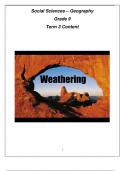
Social Sciences – Geography
Grade 9
Term 3 Content
1
,UNIT1.
➢ INTRODUCTION ( PURPOSE OF THE TRAINING)
➢ LEGISLATIVE FRAMEWORK
➢ THE CONCEPT GEOGRAPHY
Each unit is arranged as follows:
❖ Overview
❖ Aims and skills
❖ Assessment strategies
❖ Activities and
❖ Notes
❖ Annexures : Assessment exemplars
For the user:
Table of Contents
page
Introduction 2
Unit 1 3
Surface forces that shape the earth: concept of weathering 3
1.1 Physical (mechanical) weathering 4
1.2 Chemical weathering 7
1.3 Biological weathering 9
1.4 impact of human activities on weathering 11
Unit 2 13
Surface forces that shape the earth: erosion and deposition 13
2.1 Rivers – features of erosion and deposition along a river course 13
2.2 Sea – features of erosion and deposition associated with wave action:
the power of wave action and typical landforms 16
2.3 Moving ice – features of erosion and deposition associated with
glaciated landscapes 21
2.4 Wind – features of erosion and deposition associated with wind 27
Unit 3 30
Surface forces that shape the earth: the impact of people on soil erosion:
case study – agriculture as a contributor to erosion 30
❖ Some of the activities in this training manual will be performed during the training sessions in
pairs, individually and in class discussions. It is up the discretion of the facilitator which of the
exercises to emphasise and which to complete in the time allocated to the session.
❖ Additional notes in this manual will help educators to develop their own class activities
❖ It is advised that educators read the notes in the manual privately to save time during the training
session.
2
,Resources needed:
❖ Any of the prescribed Grade 9 textbook and educator’s guide.
❖ Social Sciences CAPS document.
❖ Annual Teaching Plan.
❖ Pen and paper.
❖ Projector
❖ Lap top
INTRODUCTION
Dear Social Sciences Practitioners
Welcome to the CAPS Geography Grade 9 Content knowledge training
session. This manual has been developed to assist you follow all geographic
concepts critically to every topic. In order for learners to apply enquiry skills,
they will need to have to have a full grasp and understanding of the content.
REMEMBER memory skills remain important.
Ice – breaker (inspiration)
Read through the PPT presentation on Mrs Thompson perfume as inspiration for teaching.
LEGISLATIVE FRAMEWORK
(10 minutes)
As stipulated in the Social Sciences CAPS:
Both History and Geography should be taught and assessed during every term of the year…
Learners are trained to speculate, to debate, to make connections, to select, to prioritise and to persist, in
tackling real issues and important questions.
Learners are encouraged to ask questions: Who? Where? What? Why? When? How? Should? Could? Is
\ Are? The questions learners ask give teachers a good indication of prior knowledge, perceptions,
interests, insights and concerns.
Different forms of text (oral, written and visual) are central to both disciplines
Learners should write regularly, with a clear progression in length and complexity throughout.
Concepts in Geography
Geography is the study of the human and physical environment. Geography is an integrated discipline
that examines both physical and human processes over space and time. Geography helps us to
understand our complex world. It offers us a bridge between the human and physical sciences.
3
, There are many branches of Geography. Physical Geography examines natural processes and features,
including the atmosphere, landforms and ecosystems. Human Geography is concerned with the activities
and impact of people on the earth.
The concept that unifies Geography is space. All geographical phenomena have a spatial dimension.
They also operate in a continuously changing environment.
Geography therefore includes the study of:
• spatial patterns and trends: the location of people and places in the world;
• similarity and difference: how environments and lifestyles compare and the reasons for similarities
and differences;
• movement: how and why people, goods, water, land and air move and change;
• Planet Earth: land, water and air;
• human settlement: where people live and why;
• human activities: what people do, how the environment affects them and how they affect the
environment;
• interdependence: the links between climate, vegetation, wildlife, resource distribution, and human
settlement and activity; and
• Change: the changing nature of people and places.
• Geographical education contributes to literacy, numeracy and graphicacy or spatial literacy. It also
supports the development of personal and social competence.
UNIT 1: TIME: 1 hour, 30 minutes
SURFACE FORCES THAT SHAPE THE EARTH: CONCEPT OF WEATHERING
Outcomes: at the end of the activity you will;
• define the following concepts: weathering, physical weathering, chemical weathering and biological
weathering
• identify examples of different types of weathering
• Describe/determine the impact of human activities on weathering.
Term 3: Week 1
1. WHAT IS WEATHERING?
Weathering is the process by which rocks are broken down into small particles OR is the breakdown of
rock into smaller pieces through exposure to wind, water, heat, and cold (concept).
Important facts about weathering:
• It is caused by the action of moving water, air, chemicals, plants, or animals and changing temperature.
• It is usually a very slow and invisible process.
• Weathering of rocks occurs in the same place and rocks are not moved.
4
Grade 9
Term 3 Content
1
,UNIT1.
➢ INTRODUCTION ( PURPOSE OF THE TRAINING)
➢ LEGISLATIVE FRAMEWORK
➢ THE CONCEPT GEOGRAPHY
Each unit is arranged as follows:
❖ Overview
❖ Aims and skills
❖ Assessment strategies
❖ Activities and
❖ Notes
❖ Annexures : Assessment exemplars
For the user:
Table of Contents
page
Introduction 2
Unit 1 3
Surface forces that shape the earth: concept of weathering 3
1.1 Physical (mechanical) weathering 4
1.2 Chemical weathering 7
1.3 Biological weathering 9
1.4 impact of human activities on weathering 11
Unit 2 13
Surface forces that shape the earth: erosion and deposition 13
2.1 Rivers – features of erosion and deposition along a river course 13
2.2 Sea – features of erosion and deposition associated with wave action:
the power of wave action and typical landforms 16
2.3 Moving ice – features of erosion and deposition associated with
glaciated landscapes 21
2.4 Wind – features of erosion and deposition associated with wind 27
Unit 3 30
Surface forces that shape the earth: the impact of people on soil erosion:
case study – agriculture as a contributor to erosion 30
❖ Some of the activities in this training manual will be performed during the training sessions in
pairs, individually and in class discussions. It is up the discretion of the facilitator which of the
exercises to emphasise and which to complete in the time allocated to the session.
❖ Additional notes in this manual will help educators to develop their own class activities
❖ It is advised that educators read the notes in the manual privately to save time during the training
session.
2
,Resources needed:
❖ Any of the prescribed Grade 9 textbook and educator’s guide.
❖ Social Sciences CAPS document.
❖ Annual Teaching Plan.
❖ Pen and paper.
❖ Projector
❖ Lap top
INTRODUCTION
Dear Social Sciences Practitioners
Welcome to the CAPS Geography Grade 9 Content knowledge training
session. This manual has been developed to assist you follow all geographic
concepts critically to every topic. In order for learners to apply enquiry skills,
they will need to have to have a full grasp and understanding of the content.
REMEMBER memory skills remain important.
Ice – breaker (inspiration)
Read through the PPT presentation on Mrs Thompson perfume as inspiration for teaching.
LEGISLATIVE FRAMEWORK
(10 minutes)
As stipulated in the Social Sciences CAPS:
Both History and Geography should be taught and assessed during every term of the year…
Learners are trained to speculate, to debate, to make connections, to select, to prioritise and to persist, in
tackling real issues and important questions.
Learners are encouraged to ask questions: Who? Where? What? Why? When? How? Should? Could? Is
\ Are? The questions learners ask give teachers a good indication of prior knowledge, perceptions,
interests, insights and concerns.
Different forms of text (oral, written and visual) are central to both disciplines
Learners should write regularly, with a clear progression in length and complexity throughout.
Concepts in Geography
Geography is the study of the human and physical environment. Geography is an integrated discipline
that examines both physical and human processes over space and time. Geography helps us to
understand our complex world. It offers us a bridge between the human and physical sciences.
3
, There are many branches of Geography. Physical Geography examines natural processes and features,
including the atmosphere, landforms and ecosystems. Human Geography is concerned with the activities
and impact of people on the earth.
The concept that unifies Geography is space. All geographical phenomena have a spatial dimension.
They also operate in a continuously changing environment.
Geography therefore includes the study of:
• spatial patterns and trends: the location of people and places in the world;
• similarity and difference: how environments and lifestyles compare and the reasons for similarities
and differences;
• movement: how and why people, goods, water, land and air move and change;
• Planet Earth: land, water and air;
• human settlement: where people live and why;
• human activities: what people do, how the environment affects them and how they affect the
environment;
• interdependence: the links between climate, vegetation, wildlife, resource distribution, and human
settlement and activity; and
• Change: the changing nature of people and places.
• Geographical education contributes to literacy, numeracy and graphicacy or spatial literacy. It also
supports the development of personal and social competence.
UNIT 1: TIME: 1 hour, 30 minutes
SURFACE FORCES THAT SHAPE THE EARTH: CONCEPT OF WEATHERING
Outcomes: at the end of the activity you will;
• define the following concepts: weathering, physical weathering, chemical weathering and biological
weathering
• identify examples of different types of weathering
• Describe/determine the impact of human activities on weathering.
Term 3: Week 1
1. WHAT IS WEATHERING?
Weathering is the process by which rocks are broken down into small particles OR is the breakdown of
rock into smaller pieces through exposure to wind, water, heat, and cold (concept).
Important facts about weathering:
• It is caused by the action of moving water, air, chemicals, plants, or animals and changing temperature.
• It is usually a very slow and invisible process.
• Weathering of rocks occurs in the same place and rocks are not moved.
4


