Chapter 13: Aggregate Demand and Aggregate Supply
1. Overview
LAS
In AS
fla
tion LAD
AD
GDP
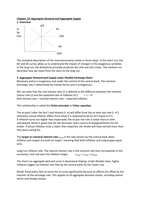
The complete description of the macroeconoomy comes in three steps. In the short run, the
AD and AS curves allow us to understand the impact of changes in the exogenous variables.
In the long run, the dichotomy principle produces the LAD and LAS curves. The medium run
describes how we move from the short to the long run.
3. Aggregate Demand and Supply under Flexible Exchange Rates
Monetary policy is exogenous and under the control of the central bank. The nominal
exchange rate is determined by market forces and is endogenous.
We can state that the real interest rate (r) is defined as the differnce between the nominal
interes rate (i) and the expected rate of inflation (πe): r = i - πe
Real interest rate = nominal interest rate – expected inflation
This relationship is called the Fisher principle or Fisher equation.
The ex post (‘after the fact’) real interest (i- π) will differ from the ex ante real rate (i- πe),
whenever actual inflation differs from what it is expected to be (π isn’t equal to πe).
If inflation turns out higher than expectedd, the ex pos real rate is lower than ex ante
anticipated, which is good new for the borrower and a source of disappointment for the
lender. If actual inflation ends u lower than expected, the lender will have earned more than
they were asking for.
The target or naeutral interest rate istripe is the rate chosen by the cnetral bank when
inflation and output are both on target –meaning that both inflation and output gaps equal
zero.
Long-run inflation rate. The natural interest rate is the nominal rate that corresponds to the
economy’s real rate plus the inflation target: istripe = rstripe + πstripe
The short-run aggregate demand curve is downward-sloping. Under flexible rates, higher
inflation triggers an interest rate hike by the central bank via the Taylor rule.
Recall: fiscal policy fails to move the IS curve significantly because its effects are offset by the
reaction of the exchange rate. This applies to all aggregate demand shocks, including animal
spirits and foreign output.
1. Overview
LAS
In AS
fla
tion LAD
AD
GDP
The complete description of the macroeconoomy comes in three steps. In the short run, the
AD and AS curves allow us to understand the impact of changes in the exogenous variables.
In the long run, the dichotomy principle produces the LAD and LAS curves. The medium run
describes how we move from the short to the long run.
3. Aggregate Demand and Supply under Flexible Exchange Rates
Monetary policy is exogenous and under the control of the central bank. The nominal
exchange rate is determined by market forces and is endogenous.
We can state that the real interest rate (r) is defined as the differnce between the nominal
interes rate (i) and the expected rate of inflation (πe): r = i - πe
Real interest rate = nominal interest rate – expected inflation
This relationship is called the Fisher principle or Fisher equation.
The ex post (‘after the fact’) real interest (i- π) will differ from the ex ante real rate (i- πe),
whenever actual inflation differs from what it is expected to be (π isn’t equal to πe).
If inflation turns out higher than expectedd, the ex pos real rate is lower than ex ante
anticipated, which is good new for the borrower and a source of disappointment for the
lender. If actual inflation ends u lower than expected, the lender will have earned more than
they were asking for.
The target or naeutral interest rate istripe is the rate chosen by the cnetral bank when
inflation and output are both on target –meaning that both inflation and output gaps equal
zero.
Long-run inflation rate. The natural interest rate is the nominal rate that corresponds to the
economy’s real rate plus the inflation target: istripe = rstripe + πstripe
The short-run aggregate demand curve is downward-sloping. Under flexible rates, higher
inflation triggers an interest rate hike by the central bank via the Taylor rule.
Recall: fiscal policy fails to move the IS curve significantly because its effects are offset by the
reaction of the exchange rate. This applies to all aggregate demand shocks, including animal
spirits and foreign output.