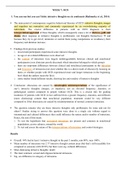
7. Explain the difference between strongly and weakly electric fishes. Which one should I be
scared of? What type of cel1s did electrocytes evolve from? What is the neurotransmitter used to
communicate between the nervous system and electrocytes? What cross-membrane protein do
electrocytes uses to generate a charge gradient?
Solution
1. Differences between Strongly and weakly electric fishes:
2. From the above discussion, it is clear that we should be scared of strongly electric fishes rather
than weakly electric fish
3. Skeletal muscles in the electric fish are evolved strongly to such an extent that they are able to
generate electric potential either for navigation or for protection from predators. High brain to
body ration, swimming backwards in some electrogenic fishes are also said to be evidences for
the evolution
4. Since, electric organs are specilizations of skeletal muscles, Acetylcholine is the
neurotransmitter involved in the transmission of impulses just like it is responsible for muscle
contraction in other animals. The effector respone is specially magnified to a level that it can
produce perceptible electric discharge
5. DESMOSOMES are the cross membrane proteins which are responsible for maintaining
stable adhesive junctions in the cell membrane. Desmosomal Proteins like Desmosomal
cadherins, desmgleins, Desmocollins are helps in generation of charge gradientSrongly electric
fishWeakly electric fish1. Strongly electric fish have an electric organ discharge which is very
strong enough to stun the prey. The elecytric dischare is too strong upto several hundred volts1
Weakly electric fish have discharges less than a single volt2. These fish use electric discharges
as a defensive mechansims to protect themselves against predators2. These use electric
discharges for object detection (electrolocation), and communication with other fishes3. They
live both in marine and fresh waters. They live superficially3. These are nocturnal fishes and
live in turbid waters4. Examples include Astrocarpus (Marine), Torpedo (Marine), Electophorus
(freshwater). Malapterurus (Freshwater)4. Examples include Raja (marine), and fresh water
fishes like Eigenmannia, Apteronotus, Gymnotus, Gymnarchus, Gnathonemus5. Potentially
harmful and can even kill humans5. No harm to the humans6. They have thick adipose tissue
layers which serves to insulate them and evade the shock by their own electric discharge6.
Comparitively these fishes have less adipose tissue layers as the discharge is too weak to harm
themselves.7. Jamming avoidance response mechanisms are not present in strong electric fish as
they use electric discharge for defense7. Jamming avoidance response mechanisms are present
to avoid miscommunication with other electroreceptive fishes
scared of? What type of cel1s did electrocytes evolve from? What is the neurotransmitter used to
communicate between the nervous system and electrocytes? What cross-membrane protein do
electrocytes uses to generate a charge gradient?
Solution
1. Differences between Strongly and weakly electric fishes:
2. From the above discussion, it is clear that we should be scared of strongly electric fishes rather
than weakly electric fish
3. Skeletal muscles in the electric fish are evolved strongly to such an extent that they are able to
generate electric potential either for navigation or for protection from predators. High brain to
body ration, swimming backwards in some electrogenic fishes are also said to be evidences for
the evolution
4. Since, electric organs are specilizations of skeletal muscles, Acetylcholine is the
neurotransmitter involved in the transmission of impulses just like it is responsible for muscle
contraction in other animals. The effector respone is specially magnified to a level that it can
produce perceptible electric discharge
5. DESMOSOMES are the cross membrane proteins which are responsible for maintaining
stable adhesive junctions in the cell membrane. Desmosomal Proteins like Desmosomal
cadherins, desmgleins, Desmocollins are helps in generation of charge gradientSrongly electric
fishWeakly electric fish1. Strongly electric fish have an electric organ discharge which is very
strong enough to stun the prey. The elecytric dischare is too strong upto several hundred volts1
Weakly electric fish have discharges less than a single volt2. These fish use electric discharges
as a defensive mechansims to protect themselves against predators2. These use electric
discharges for object detection (electrolocation), and communication with other fishes3. They
live both in marine and fresh waters. They live superficially3. These are nocturnal fishes and
live in turbid waters4. Examples include Astrocarpus (Marine), Torpedo (Marine), Electophorus
(freshwater). Malapterurus (Freshwater)4. Examples include Raja (marine), and fresh water
fishes like Eigenmannia, Apteronotus, Gymnotus, Gymnarchus, Gnathonemus5. Potentially
harmful and can even kill humans5. No harm to the humans6. They have thick adipose tissue
layers which serves to insulate them and evade the shock by their own electric discharge6.
Comparitively these fishes have less adipose tissue layers as the discharge is too weak to harm
themselves.7. Jamming avoidance response mechanisms are not present in strong electric fish as
they use electric discharge for defense7. Jamming avoidance response mechanisms are present
to avoid miscommunication with other electroreceptive fishes