Biological Molecules
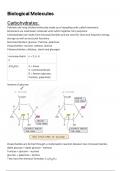
Carbohydrates:
Polymers are long chained molecules made up of repeating units called monomers.
Monomers are small basic molecular units which together form polymers.
Carbohydrates are made from monosaccharides and are used for short and long term energy
storage as well as structural functions.
Monosaccharides: glucose, fructose, galactose
Disaccharides: sucrose, maltose, lactose
Polysaccharides: cellulose, starch and glycogen
monosaccharid n = 3 ,5, 6
e
(CH2O)n 3 = triose
5 = pentose(ribose)
6 = hexose (glucose,
fructose, galactose)
Isomers of glucose:
Disaccharides are formed through a condensation reaction between two monosaccharides.
alpha glucose + alpha glucose - maltose
fructose + glucose - sucrose
glucose + galactose - lactose
They have the chemical formulae: C12H22O11
, Condensation of two alpha glucose monosaccharides:
Hydrolysis can be used to break down polymers by using a water molecule.
Carbohydrates:
Polymers are long chained molecules made up of repeating units called monomers.
Monomers are small basic molecular units which together form polymers.
Carbohydrates are made from monosaccharides and are used for short and long term energy
storage as well as structural functions.
Monosaccharides: glucose, fructose, galactose
Disaccharides: sucrose, maltose, lactose
Polysaccharides: cellulose, starch and glycogen
monosaccharid n = 3 ,5, 6
e
(CH2O)n 3 = triose
5 = pentose(ribose)
6 = hexose (glucose,
fructose, galactose)
Isomers of glucose:
Disaccharides are formed through a condensation reaction between two monosaccharides.
alpha glucose + alpha glucose - maltose
fructose + glucose - sucrose
glucose + galactose - lactose
They have the chemical formulae: C12H22O11
, Condensation of two alpha glucose monosaccharides:
Hydrolysis can be used to break down polymers by using a water molecule.