GCSE AQA Chemistry Exam 100% Marking Scheme
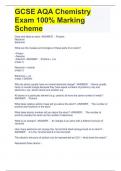
GCSE AQA Chemistry Exam 100% Marking Scheme Draw and label an atom -ANSWER Protons Neutrons Electrons What are the masses and charges of these parts of an atom? • Proton • Neutron • Electron -ANSWER Protons = +ve (mass 1) Neutrons = neutral (mass 1) Electrons = -ve (mass 1/2000th) Why do atoms usually have no overall electrical charge? -ANSWER Atoms usually have no overall charge because they have equal numbers of protons (+ve) and electrons (-ve), which cancel one another out All atoms of a particular element (e.g. carbon) all have the same number of what? -ANSWER Protons What does relative atomic mass tell you about the atom? -ANSWER The number of protons and neutrons in the atom What does atomic number tell you about the atom? -ANSWER The number of protons (usually the same as the number of electrons) What is an isotope? -ANSWER An isotope is an atom with a different amount of neutrons How many electrons can occupy the 1st and 2nd shell (energy level) of an atom? -ANSWER 2 in the 1st shell and 8 in the 2nd shell The electron structure of sodium can be represented as 2,8,1 - what does this mean? Represent these atoms: - • Fluorine • Oxygen • Potassium • Magnesium -ANSWER 2,8,1 means 2 electrons in the 1st shell, 8 electrons in the 2nd shell and 1 electron in the 3rd shell Fluorine = 2,7 Oxygen = 2,6 Potassium = 2,8,8,1 Magnesium = 2,8,2 Define these terms: - • Element • Compound • Mixture -ANSWER Element - a pure substance made from 1 type of atom only Compound - 2 or more elements chemically bound
Written for
- Institution
- GCSE AQA Chemistry
- Course
- GCSE AQA Chemistry
Document information
- Uploaded on
- June 17, 2023
- Number of pages
- 15
- Written in
- 2022/2023
- Type
- Exam (elaborations)
- Contains
- Questions & answers
Subjects
-
gcse aqa
-
gcse aqa chemistry
-
gcse aqa chemistry exam 100 marking scheme

Document also available in package deal