ATI PEDIATRICS PROCTORED 2019 EXAM – STUDY GUIDE.
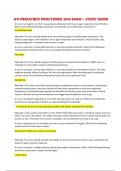
ATI PEDIATRICS PROCTORED 2019 EXAM – STUDY GUIDE. A nurse in an urgent care clinic is assessing an adolescent who has an upper respiratory tract infection. Which of the following findings should the nurse identify as a manifestation of pertussis? Dry, hacking cough Rationale: The nurse should identify that a dry, hacking cough is a manifestation of pertussis. This disease usually begins with indications of an upper respiratory tract infection, which includes a dry, hacking cough that is sometimes more severe at night. A nurse is caring for a school-age child who is receiving a blood transfusion. Which of the following manifestations should alert the nurse to a possible hemolytic transfusion reaction? Flank pain Rationale: The nurse should recognize that flank pain is caused by the breakdown of RBCs and is an indication of a hemolytic reaction to the blood transfusion. A nurse is caring for a school-age child who is receiving cefazolin via intermittent IV bolus. The child suddenly develops diffuse flushing of the skin and angioedema. After discontinuing the medication infusion, which of the following medications should the nurse administer first? Epinephrine Rationale: This child is most likely experiencing an anaphylactic reaction to the cefazolin. According to evidence-based practice, the nurse should first administer epinephrine to treat the anaphylaxis. Epinephrine is a beta adrenergic agonist that stimulates the heart, causes vasoconstriction of blood vessels in the skin and mucous membranes, and triggers bronchodilation in the lungs. A nurse is teaching the guardian of a 6-month-old infant about car seat use. Which of the following statements by the guardian indicates an understanding of the teaching? "I should secure the car seat using lower anchors and tethers instead of the seat belt." Rationale: Lower anchors and tethers, or the LATCH child safety seat system, should be used to secure an infant's car seat in the vehicle. This system provides anchors between the front cushion and the back rest for the car seat. Therefore, if this system is available, the seat belt does not have to be used. A nurse is planning care for a toddler who has a serum lead level of 4 mcg/dL. Which of the following actions should the nurse plan to take? Schedule the toddler for a yearly rescreening. Rationale: The nurse should schedule the toddler for a lead level rescreening in 1 year and educate the family on ways to prevent exposure. A nurse is caring for a toddler who has spastic (pyramidal) cerebral palsy. Which of the following findings should the nurse expect? (Select all that apply.) -Ankle clonus -Exaggerated stretch reflexes -Contractures A nurse is assessing a school-age child immediately following a perforated appendix repair. Which of the following findings should the nurse expect? Absence of peristalsis Rationale: The nurse should expect absence of peristalsis immediately following a perforated appendix repair, until the bowel resumes functioning. A nurse is planning care for a school-age child who is in the oliguric phase of acute kidney injury (AKI) and has a sodium level of 129 mEq/L. Which of the following interventions should the nurse include in the plan? Initiate seizure precautions for the child. Rationale: A sodium level of 129 mEq/L indicates hyponatremia and places the child at increased risk for neurological deficits and seizure activity. The nurse should complete a neurologic assessment and implement seizure precautions to maintain the child's safety. A nurse is teaching the parent of an infant who has a Pavlik harness for the treatment of developmental dysplasia of the hip. The nurse should identify that which of the following statements by the parent indicates an understanding of the teaching? "I will place my infant's diapers under the harness straps." Rationale: To prevent soiling of the harness, the parent should apply the infant's diaper under the straps. A nurse is reviewing the laboratory report of a school-age child who is experiencing fatigue. Which of the following findings should the nurse recognize as an indication of anemia? Hematocrit 28% Rationale: The nurse should recognize that this hematocrit level is below the expected reference range of 32% to 44% for a school-age child. The child can exhibit fatigue, lightheadedness, tachycardia, dyspnea, and pallor due to the decreased oxygen-carrying capacity. A nurse is assessing a 4-year-old child at a well-child visit. Which of the following developmental milestones should the nurse expect to observe? Cuts an outlined shape using scissors. Rationale: The nurse should recognize that an expected developmental milestone of a 4-year-old child is using scissors to cut out a shape. A nurse is caring for a preschooler who is scheduled for hydrotherapy treatment for wound debridement following a burn injury. Which of the following actions should the nurse take prior to the procedure? Administer an analgesic to the child. Rationale: Hydrotherapy for debridement of a wound is an extremely painful procedure which requires analgesia and/or sedation. When pain is controlled, it leads to reduced physiological demands on the body caused by stress and decreases the likelihood of children developing depression and post-traumatic stress disorder. A nurse is creating a plan of care for a school-age child who has heart disease and has developed heart failure. Which of the following interventions should the nurse include in the plan? Provide small, frequent meals for the child. Rationale: The metabolic rate of a child who has heart failure is high because of poor cardiac function. Therefore, the nurse should provide small, frequent meals for the child because it helps to conserve energy. A nurse is teaching the parents of a school-age child who has a new diagnosis of osteomyelitis of the tibia. The nurse should identify that which of the following statements by the parents indicates an understanding of the teaching? "My child will receive antibiotics for several weeks." Rationale: The nurse should instruct the parent that the child will receive antibiotic therapy for at least 4 weeks. Surgery might be indicated if the antibiotics are not successful. A nurse is providing teaching to the parent of an infant who has diaper dermatitis. The nurse should instruct the parent to apply which of the following to the affected area? Zinc oxide.
Written for
- Institution
- ATI PEDIATRICS
- Course
- ATI PEDIATRICS
Document information
- Uploaded on
- June 16, 2023
- Number of pages
- 12
- Written in
- 2022/2023
- Type
- Exam (elaborations)
- Contains
- Questions & answers
Subjects
-
ati pediatrics proctored 2019 exam – study guide
-
ati pediatrics proctored 2019 exam
-
ati pediatrics proctored exam – study guide
-
ati pediatrics proctored – study guide
-
ati pediatrics 2019 exam – st

Document also available in package deal