Leadership (Army Board Study Guide) 100% Pass
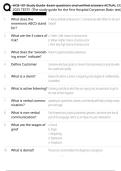
Leadership (Army Board Study Guide) 100% Pass What does FM 6-22 cover? Army Leadership (Competent, Confident and Agile) What does FM 7-0 cover? Training the force Define Leadership Leadership is influencing people by providing purpose, direction, and motivation while operating to accomplish the mission and improving the organization. What is purpose? Purpose gives subordinates the reason to act in order to achieve a desired outcome. What is direction? Providing clear direction involves communicating how to accomplish a mission: prioritizing tasks, assigning responsibility for completion, and ensuring subordinates understand the standard. What is motivation? Motivation supplies the will to do what is necessary to accomplish a mission. Describe the "Be, Know and Do". Army leadership begins with what the leader must BE, the values and attributes that shape a leader's character. Your skills are those things you KNOW how to do, your competence in everything from the technical side of your job to the people skills a leader requires. But character and knowledge while absolutely necessary are not enough. You cannot be effective, you cannot be a leader, until you apply what you know, until you act and DO what you must. What are the three principal ways that leaders can develop others through which they provide knowledge and feedback? 1. Counseling 2. Coaching 3. Mentoring A leader's effectiveness is dramatically enhanced by understanding and developing what areas? 1. Military Bearing 2. Physical Fitness 3. Confidence 4. Resilience What is military bearing? Projecting a commanding presence, a professional image of authority. What is physical fitness? Having sound health, strength, and endurance, which sustain emotional health and conceptual abilities under prolonged stress. What is confidence? Projecting self-confidence and certainty in the unit's ability to succeed in whatever it does; able to demonstrate composure and outward calm through steady control over emotion. What is resilience? Showing a tendency to recover quickly from setbacks, shock, injuries, adversity, and stress while maintaining a mission and organizational focus. What are the three core domains that shape the critical learning experiences throughout Soldiers' and leaders' careers? 1. Institutional training. 2. Training, education, and job experience gained during operational assignments. 3. Self-development. What are the Leader Actions? 1. Influencing - getting people (Soldiers, Army civilians, and multinational partners) to do what is necessary. 2. Operating - the actions taken to influence others to accomplish missions and to set the stage for future operations. 3. Improving - capturing and acting on important lessons of ongoing and completed projects and missions. What are the three levels of leadership? 1. Direct - Direct leadership is face-to-face, first-line leadership. 2. Organizational - Organizational leaders influence several hundred to several thousand people. They do this indirectly, generally through more levels of subordinates than do direct leaders. 3. Strategic - Strategic leaders include military and DA civilian leaders at the major command through Department of Defense levels. Strategic leaders are responsible for large organizations and influence several thousand to hundreds of thousands of people. What are the Army Values? 1. Loyalty 2. Duty 3. Respect 4. Selfless Service 5. Honor 6. Integrity 7. Personal Courage Attributes of an Army leader can best be defined as what an Army leader is. What are the attributes of an Army leader? 1. A leader of character 2. A leader with presence 3. A leader with intellectual capacity Core leader competencies are what an Army leader does. What are the core leader competencies? 1. An Army leader leads 2. An Army leader develops 3. An Army leader achieves. Why must leaders introduce stress into training? Using scenarios that closely resemble the stresses and effects of the real battlefield is essential to victory and survival in combat. What are intended and unintended consequences? Intended consequences are the anticipated results of a leader's decisions and actions. Unintended consequences arise from unplanned events that affect the organization or accomplishment of the mission. What is communication? A process of providing information Name the two barriers of communications 1. Physical 2. Psychological Name some physical barriers of communication 1. Noise of battle 2. Distance What is counseling? Counseling is the process used by leaders to review with a subordinate the subordinate's demonstrated performance and potential. What are the three major categories of developmental counseling? 1. Event counseling 2. Performance counseling 3. Professional growth counseling Character is essential to successful leadership. What are the three major factors that determine a leader's character? 1. Army Values 2. Empathy 3. Warrior Ethos What are the 7 steps to problem solving? 1. ID the problem 2. Gather information 3. Develop criteria 4. Generate possible solutions 5. Analyze possible solutions 6. Compare possible solutions 7. Make and implement the decision What is reverse planning? Reverse planning is a specific technique used to ensure that a concept leads to the intended end state To assess subordinates, leaders you must 1. Observe and record subordinates' performance in the core leader competencies. 2. Determine if the performances meet, exceed, or fall below expected standards. 3. Tell subordinates what was observed and give an opportunity to comment. 4. Help subordinates develop an individual development plan (IDP) to improve performance What are the team building stages? 1. Formation 2. Enrichment 3. Sustainment Name some things in a unit that affect morale 1. Mess 2. Military justice 3. Mail 4. Supply 5. Billets What are beliefs? Beliefs derive from upbringing, culture, religious backgrounds and traditions.
Written for
- Institution
- Leadership
- Course
- Leadership
Document information
- Uploaded on
- June 15, 2023
- Number of pages
- 8
- Written in
- 2022/2023
- Type
- Exam (elaborations)
- Contains
- Questions & answers
Subjects
-
leadership army board study guide 100 pass
-
what does fm 6 22 cover army leadership compet

Document also available in package deal