HOOFDSTUK 1
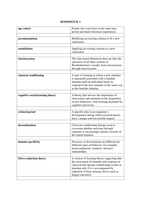
age cohort People who were born in the same time
period and share historical experiences.
accommodation Modifying an existing schema to fit a new
experience.
assimilation Applying an existing schema to a new
experience.
chronosystem The time-based dimension that can alter the
operation of all other systems in
Bronfenbrenner’s model, from microsystem
through macrosystem.
classical conditioning A type of learning in which a new stimulus
is repeatedly presented with a familiar
stimulus until an individual learns to
respond to the new stimulus in the same way
as the familiar stimulus.
cognitive social learning theory A theory that stresses the importance of
observation and imitation in the acquisition
of new behaviors, with learning mediated by
cognitive processes.
critical period A specific time in an organism’s
development during which external factors
have a unique and irreversible impact.
desensitization Classical conditioning therapy used to
overcome phobias and fears through
exposure to increasingly intense versions of
the feared stimulus.
domain specificity Processes of development are different for
different types of behavior, for example,
moral judgments, manners, and peer
relationships.
Drive-reduction theory A version of learning theory suggesting that
the association of stimulus and response in
classical and operant conditioning results in
learning only if it is accompanied by
reduction of basic primary drives such as
hunger and thirst.
age cohort People who were born in the same time
period and share historical experiences.
accommodation Modifying an existing schema to fit a new
experience.
assimilation Applying an existing schema to a new
experience.
chronosystem The time-based dimension that can alter the
operation of all other systems in
Bronfenbrenner’s model, from microsystem
through macrosystem.
classical conditioning A type of learning in which a new stimulus
is repeatedly presented with a familiar
stimulus until an individual learns to
respond to the new stimulus in the same way
as the familiar stimulus.
cognitive social learning theory A theory that stresses the importance of
observation and imitation in the acquisition
of new behaviors, with learning mediated by
cognitive processes.
critical period A specific time in an organism’s
development during which external factors
have a unique and irreversible impact.
desensitization Classical conditioning therapy used to
overcome phobias and fears through
exposure to increasingly intense versions of
the feared stimulus.
domain specificity Processes of development are different for
different types of behavior, for example,
moral judgments, manners, and peer
relationships.
Drive-reduction theory A version of learning theory suggesting that
the association of stimulus and response in
classical and operant conditioning results in
learning only if it is accompanied by
reduction of basic primary drives such as
hunger and thirst.