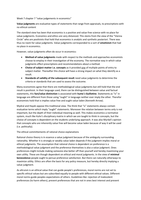
Week 7 chapter 7 “value judgements in economics”
Value judgments are evaluative types of statements that range from appraisals, to prescirptions with
no ethical content
The standard view has been that economics is a positive and value-free science with no place for
value-judgments. Economics and ethics are very distanced. This stems from the view of the “Vienna
Circle” who are positivists that hold that economics is analytic and synthetic posteriori. There was
thus no room for value judgments. Value-judgments corresponded to a sort of emotivism that had
no place in economics.
However, value-judgments often do occur in economics:
Method of value judgments made with respect to the methods and approaches economists
choose to employ in their investigation of the economy. The normative way in which value
judgments effect prescriptions and recommendations about a method.
Choice of subject matter i.e. concepts as it provided one of multiple points of entry to
subject matter. Thereafter this choice will have a strong impact on what they identify as a
result.
Standards of validity of the subsequent result need value judgments to determine the
criteria or standards that are used to assess the outcome.
Many economists agree that there are methodological value judgments but still hold that the end
result is positivist. In their language used, there can be distinguished between value and factual
statements, this fact/value distinction is associated with hume´s Guillotine. Statements as “is” in
language are different from those using “ought” in language neither ever imply the other. Therefor
economists hold that is implies value free and ought value laden (Kenneth Arrow).
Mydral and Hayek oppose this traditional view. The think that “is” statements always contain
evaluative terms which imply “ought” statements. Moreover the relation between terms only is not
important, but the depth of their individual meaning as well. This makes economics a normative
system, much like Kuhn’s disciplinary matrix in which we are taught to think in concepts, but the
choice of concepts is dependent on the students underlying approach. It was also Myrdal’s opinion
that concepts who are inherently value free will become value laden because of way it will be used
(i.e. politically).
The ethical committements of rational choice explanations
Rational choice theory is in essence a value judgment because of the ambiguity surrounding
rationality. Whether it is strongly or weakly value laden depends if the judgment implies moral or
ethical judgments. The assumption that rational choice is dependent on preference is a
methodological value judgment and the preference themselves is also a value judgment. Ones
preferences might include making someone else better off than yourself and hereby maximizing your
own utility. These are though dependent on ethical and moral judgments. In the view of minimal
benevolence people ought to persue preference satisfaction. But there can naturally otherways to
maximize utility. Ethics are often the basis for any policy measure, but hereby directly implying a
value judgment.
As altruism is an ethical value that can guide people’s preferences, moral norms are not set to
specific ethical values but are subscribed equally to people with different ethical values. Different
moral norms guide peoples expectations of others. Guidelines like: rejection of malevolent
preferences (to harm others), prevent preferences that are not in ones best interest and prevent
Value judgments are evaluative types of statements that range from appraisals, to prescirptions with
no ethical content
The standard view has been that economics is a positive and value-free science with no place for
value-judgments. Economics and ethics are very distanced. This stems from the view of the “Vienna
Circle” who are positivists that hold that economics is analytic and synthetic posteriori. There was
thus no room for value judgments. Value-judgments corresponded to a sort of emotivism that had
no place in economics.
However, value-judgments often do occur in economics:
Method of value judgments made with respect to the methods and approaches economists
choose to employ in their investigation of the economy. The normative way in which value
judgments effect prescriptions and recommendations about a method.
Choice of subject matter i.e. concepts as it provided one of multiple points of entry to
subject matter. Thereafter this choice will have a strong impact on what they identify as a
result.
Standards of validity of the subsequent result need value judgments to determine the
criteria or standards that are used to assess the outcome.
Many economists agree that there are methodological value judgments but still hold that the end
result is positivist. In their language used, there can be distinguished between value and factual
statements, this fact/value distinction is associated with hume´s Guillotine. Statements as “is” in
language are different from those using “ought” in language neither ever imply the other. Therefor
economists hold that is implies value free and ought value laden (Kenneth Arrow).
Mydral and Hayek oppose this traditional view. The think that “is” statements always contain
evaluative terms which imply “ought” statements. Moreover the relation between terms only is not
important, but the depth of their individual meaning as well. This makes economics a normative
system, much like Kuhn’s disciplinary matrix in which we are taught to think in concepts, but the
choice of concepts is dependent on the students underlying approach. It was also Myrdal’s opinion
that concepts who are inherently value free will become value laden because of way it will be used
(i.e. politically).
The ethical committements of rational choice explanations
Rational choice theory is in essence a value judgment because of the ambiguity surrounding
rationality. Whether it is strongly or weakly value laden depends if the judgment implies moral or
ethical judgments. The assumption that rational choice is dependent on preference is a
methodological value judgment and the preference themselves is also a value judgment. Ones
preferences might include making someone else better off than yourself and hereby maximizing your
own utility. These are though dependent on ethical and moral judgments. In the view of minimal
benevolence people ought to persue preference satisfaction. But there can naturally otherways to
maximize utility. Ethics are often the basis for any policy measure, but hereby directly implying a
value judgment.
As altruism is an ethical value that can guide people’s preferences, moral norms are not set to
specific ethical values but are subscribed equally to people with different ethical values. Different
moral norms guide peoples expectations of others. Guidelines like: rejection of malevolent
preferences (to harm others), prevent preferences that are not in ones best interest and prevent