Single-Factor Model
Building a Single-Factor Model:
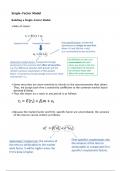
• Rate of return:
• Some securities are more sensitive to shocks to the macroeconomy than others.
Thus, we assign each rm a sensitivity coe cient to the common market factor
denoted β (beta).
• Thus the return on a stock in any period is as follows:
• Because the market factor and rm-speci c factor are uncorrelated, the variance
of the returns can be written as follows:
fi fi fiffi
,• What if we want to combine securities together in a portfolio?
- Firm speci c surprises are uncorrelated meaning that the only source of
covariance between any pair of securities is their common dependence on the
market factor.
- Therefore, the covariance between two rms’ returns depends on the
sensitivity of each to the market, as measured by their betas:
The Single-Index Model (SIM)
The Equation of the SIM:
• To make the single factor model operative, we identify the market factor as a
broad market index because it a ects the returns on all stocks which gives us
the single-index model (SIM).
• The single-index model does not have a theoretical foundation, it is simply a
way to describe the typical relationship between market returns and the returns
on a particular security.
• The excess returns on the market (the market risk premium) are given as: RM
= rM – rf and the associated risk is denoted as σM.
• The excess returns of the security are denoted as: Ri = ri – rf
• To obtain the single-index model, we regress the historical excess returns of
security i on the historical excess returns of the index for period t:
fi ff fi
,Expected return-beta relationship:
Variance for security i:
If we want to combine securities together:
, Portfolio return:
Portfolio Variance:
E ects of diversi cation on the variance:
• where: ^2( ) is the average of the rm-speci c variances.
• Because the average unsystematic risk is independent of n, when n gets large,
^2( p) becomes negligible and rm speci c risk is diversi ed away.
Residual standard deviation: rm speci c residual deviation: ^2( p). Firm
speci c risk will be low or 0 if the business is fully diversi ed
𝜎 ff 𝑒fi 𝜎
𝑒 fi fi fi fi fi fi fi fifi 𝜎 𝑒
Building a Single-Factor Model:
• Rate of return:
• Some securities are more sensitive to shocks to the macroeconomy than others.
Thus, we assign each rm a sensitivity coe cient to the common market factor
denoted β (beta).
• Thus the return on a stock in any period is as follows:
• Because the market factor and rm-speci c factor are uncorrelated, the variance
of the returns can be written as follows:
fi fi fiffi
,• What if we want to combine securities together in a portfolio?
- Firm speci c surprises are uncorrelated meaning that the only source of
covariance between any pair of securities is their common dependence on the
market factor.
- Therefore, the covariance between two rms’ returns depends on the
sensitivity of each to the market, as measured by their betas:
The Single-Index Model (SIM)
The Equation of the SIM:
• To make the single factor model operative, we identify the market factor as a
broad market index because it a ects the returns on all stocks which gives us
the single-index model (SIM).
• The single-index model does not have a theoretical foundation, it is simply a
way to describe the typical relationship between market returns and the returns
on a particular security.
• The excess returns on the market (the market risk premium) are given as: RM
= rM – rf and the associated risk is denoted as σM.
• The excess returns of the security are denoted as: Ri = ri – rf
• To obtain the single-index model, we regress the historical excess returns of
security i on the historical excess returns of the index for period t:
fi ff fi
,Expected return-beta relationship:
Variance for security i:
If we want to combine securities together:
, Portfolio return:
Portfolio Variance:
E ects of diversi cation on the variance:
• where: ^2( ) is the average of the rm-speci c variances.
• Because the average unsystematic risk is independent of n, when n gets large,
^2( p) becomes negligible and rm speci c risk is diversi ed away.
Residual standard deviation: rm speci c residual deviation: ^2( p). Firm
speci c risk will be low or 0 if the business is fully diversi ed
𝜎 ff 𝑒fi 𝜎
𝑒 fi fi fi fi fi fi fi fifi 𝜎 𝑒