Probability and Statistics II week 12
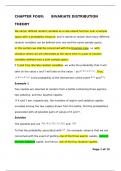
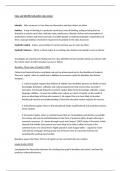
CHAPTER FOUR: BIVARIATE DISTRIBUTION THEORY We earlier defined random variable as a real-valued function over a sample space with a probability measure, and it stands to reason that many different random variables can be defined over one and the same sample space. In this section we shall be concerned with the bivariate case, i.e. with situation where we are interested at the same time in a pair of random variables defined over a joint sample space. If X and Yare discrete random variables, we write the probability that X will take on the value x and Y will take on the value as .Thus, is the probability of the intersection of the event and Example 1 Two caplets are selected at random from a bottle containing three aspirins, two sedative, and four laxative caplets. If X and Y are, respectively, the numbers of aspirin and sedative caplets included among the two caplets drawn from the bottle, find the probabilities associated with all possible pairs of values of X and Y. Solution The possible pair are and To find the probability associated with , for example, observe that we are concerned with the event of getting one of the three aspirin caplets, none of the two sedative caplet, and hence, one of the four laxative caplets. The no. of ways in which this can be done is and the total number of ways in which two of the nine caplets can be selected is Since these possibilities are all equally likely by virtue of the assumption that the selection is random, it follows that the probability associated with is , Similarly, the probability associated with is: , the probability associated with is: and continuing this way, we obtain the values shown in the following table: x y 0 1 2 0 1 0 2 0 0 It is generally preferably to represent probabilities such as these by means of formula. In other words, it is preferable to express the probabilities by means of a function with the values for any pair of values within the range of the random variables and . For instance, for the two random variables of the above example, we can write
Written for
- Institution
- Probability
- Course
- Probability
Document information
- Uploaded on
- May 31, 2023
- Number of pages
- 13
- Written in
- 2022/2023
- Type
- Class notes
- Professor(s)
- Prof kinyanjui
- Contains
- Week 12
Subjects
-
theorem 1
-
theorem 2
-
two sedative
-
chapter four bivariate distribution theory
-
example 1 two caplets are selected at random from a bottle containing three aspirins
-
and four laxative caplets if x and

Document also available in package deal