

Matthew Eggett
Business Management
Chapter 1
The business world and business management
Role of business in society
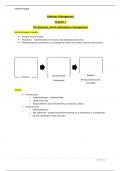
Involves human activity.
Production – transformation of resources into products and services.
Produce products and services, to exchange for money or for other products and services.
Mixers
flour Business
Bread
sugar (bakery)
labour Products
Transformation
Resource
s (Production) (Products/services for
exchange)
Sectors
Formal sector
o Large businesses – standard bank
o Listed on the JSE
o Responsible for most of South Africa’s economic activity
Informal sector
o Microenterprises
o Not registered + people involved live primarily on a subsistence or survival basis.
o Do not contribute to rates and taxes
1|Page
, Matthew Eggett
Society’s limited resources
Unlimited needs: Limited resources:
1. Physiological needs 1. Natural resources
SATISFACTION OF
2. Safety needs 2. Human resources
THE NEEDS OF
3. Social needs SOCIETY 3. Capital
4.Esteem needs 4. Entrepreneurship
5. Self-relisation needs (including management)
Natural resources
o Production factor of land
Agricultural
Industrial sites
Residential stands
Minerals and forest
Metals
Water
o The amount of natural resources any one country possesses is given, and is in most
cases, therefore, scarce.
Human resources
o A.K.A production factor of labour, include the physical and mental talents and skills
of people employed to create products of services.
o People receive wages for their labour.
o Size of labour force = size of the population, level of education and training,
promotion of women in the labour force and the retirement age.
Capital
o Represented by:
2|Page
, Matthew Eggett
Machinery
Buildings
Cash registers
Computers
Entrepreneurship
o Fourth factor or production
o Collective capacity of entrepreneurs, who are those individuals who accept the risks
involved in providing products and services for their society.
o If they are successful then the risk of investing their capital will result in profits if
they are successful. However, if they fail the may lose a lot.
Main economic systems
Market economy
o Most products and services demanded by the community are supplied by private
organisations seeking profits. It functions on the following assumptions:
Members of community may possess assets and earn profits on these.
The allocation of resources is affected by free markets.
Members of the community can freely choose between products, services,
places of residence and careers.
The state keeps its interference in the system to a minimum.
3|Page
Business Management
Chapter 1
The business world and business management
Role of business in society
Involves human activity.
Production – transformation of resources into products and services.
Produce products and services, to exchange for money or for other products and services.
Mixers
flour Business
Bread
sugar (bakery)
labour Products
Transformation
Resource
s (Production) (Products/services for
exchange)
Sectors
Formal sector
o Large businesses – standard bank
o Listed on the JSE
o Responsible for most of South Africa’s economic activity
Informal sector
o Microenterprises
o Not registered + people involved live primarily on a subsistence or survival basis.
o Do not contribute to rates and taxes
1|Page
, Matthew Eggett
Society’s limited resources
Unlimited needs: Limited resources:
1. Physiological needs 1. Natural resources
SATISFACTION OF
2. Safety needs 2. Human resources
THE NEEDS OF
3. Social needs SOCIETY 3. Capital
4.Esteem needs 4. Entrepreneurship
5. Self-relisation needs (including management)
Natural resources
o Production factor of land
Agricultural
Industrial sites
Residential stands
Minerals and forest
Metals
Water
o The amount of natural resources any one country possesses is given, and is in most
cases, therefore, scarce.
Human resources
o A.K.A production factor of labour, include the physical and mental talents and skills
of people employed to create products of services.
o People receive wages for their labour.
o Size of labour force = size of the population, level of education and training,
promotion of women in the labour force and the retirement age.
Capital
o Represented by:
2|Page
, Matthew Eggett
Machinery
Buildings
Cash registers
Computers
Entrepreneurship
o Fourth factor or production
o Collective capacity of entrepreneurs, who are those individuals who accept the risks
involved in providing products and services for their society.
o If they are successful then the risk of investing their capital will result in profits if
they are successful. However, if they fail the may lose a lot.
Main economic systems
Market economy
o Most products and services demanded by the community are supplied by private
organisations seeking profits. It functions on the following assumptions:
Members of community may possess assets and earn profits on these.
The allocation of resources is affected by free markets.
Members of the community can freely choose between products, services,
places of residence and careers.
The state keeps its interference in the system to a minimum.
3|Page


