

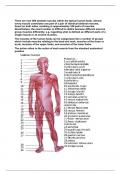
There are over 600 skeletal muscles within the typical human body. Almost
every muscle constitutes one part of a pair of identical bilateral muscles,
found on both sides, resulting in approximately 320 pairs of muscles.
Nevertheless, the exact number is difficult to define because different sources
group muscles differently, e.g. regarding what is defined as different parts of a
single muscle or as several muscles.
The muscles of the human body can be categorized into a number of groups
which include muscles relating to the head and neck, muscles of the torso or
trunk, muscles of the upper limbs, and muscles of the lower limbs.
The action refers to the action of each muscle from the standard anatomical
position
,
,
, Head
Forehead/eyelid
Antagonis
Muscle Origin Insertion Artery Nerve Action
t
occipitofro 2 occipital be galea facial nerve raises the
ntalis llies and aponeurotica eyebrows
2 frontal belli
es.
occipitalis superior galea occipital posterior moves the
nuchal line of aponeurotica artery auricular scalp back
the occipital nerve (facia
bone; mastoi l nerve)
d part of the
temporal
bone
frontalis galea skin of frontal ophthalmic facial nerve wrinkles e
aponeurotica region artery yebrow
orbicularis frontal lateral ophthalmic, zygomatic closes eye levator
oculi bone; medial palpebral zygomatico- branchof fa lids palpebrae
palpebral raphe orbital, ang cial superioris
ligament; lac ular
rimal bone
corrugator superciliary forehead skin, facial nerve wrinkles
supercilii arches near eyebrow forehead
depressor medial medial aspect facial nerve Depresses
supercilii orbital rim of bony orbit the
every muscle constitutes one part of a pair of identical bilateral muscles,
found on both sides, resulting in approximately 320 pairs of muscles.
Nevertheless, the exact number is difficult to define because different sources
group muscles differently, e.g. regarding what is defined as different parts of a
single muscle or as several muscles.
The muscles of the human body can be categorized into a number of groups
which include muscles relating to the head and neck, muscles of the torso or
trunk, muscles of the upper limbs, and muscles of the lower limbs.
The action refers to the action of each muscle from the standard anatomical
position
,
,
, Head
Forehead/eyelid
Antagonis
Muscle Origin Insertion Artery Nerve Action
t
occipitofro 2 occipital be galea facial nerve raises the
ntalis llies and aponeurotica eyebrows
2 frontal belli
es.
occipitalis superior galea occipital posterior moves the
nuchal line of aponeurotica artery auricular scalp back
the occipital nerve (facia
bone; mastoi l nerve)
d part of the
temporal
bone
frontalis galea skin of frontal ophthalmic facial nerve wrinkles e
aponeurotica region artery yebrow
orbicularis frontal lateral ophthalmic, zygomatic closes eye levator
oculi bone; medial palpebral zygomatico- branchof fa lids palpebrae
palpebral raphe orbital, ang cial superioris
ligament; lac ular
rimal bone
corrugator superciliary forehead skin, facial nerve wrinkles
supercilii arches near eyebrow forehead
depressor medial medial aspect facial nerve Depresses
supercilii orbital rim of bony orbit the


