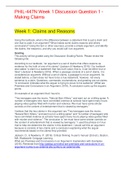
PHIL-447N Week 1 Discussion Question 1 – Making Claims
Week 1: Claims and Reasons Using the textbook, what is the difference between a statement that is just a claim and one that is used in an argument? What makes some claims reasons and others conclus ions? Using the text or other source(s), provide a simple argument, and identify the claims, the reason(s), and why you would call it an argument. Grading This activity will be graded using the Discussion Grading Rubric. Please review the following link: According to our textbook, "an argument is a set of claims that offers reasons as evidence for the truth of one of its claims" (Jackson & Newberry 2016). Our textbook also states "a claim is a statement that has truth-value; that is, it can be either true or false" (Jackson & Newberry 2016). When a passage consists of a set of claims, it is considered an argument. Without a set of claims, a passage is not an argument. As stated before, a claim does not have to be a true statement, however, not every sentence is a claim. Questions, commands, exclamations, and greeting are not claims. "A conclusion indicates what the arguer is trying to prove to his audience" (What are Premises and Conclusions in an Argument, 2016). A conclusion sums up the arguers points. An example of an argument that I found is "Two teenagers saw the movie, "Natural Born Killers," and went out on a killing spree. A number of teenagers who have committed violence at schools have spent many hours playing video games filled with murder and violence. We must have some stricter controls on the content of entertainment that is viewed by teenagers." I believe that the two claims in this argument are "Two teenagers saw the movie, "Natural Born Killers," and went out on a killing spree" and "A number of teenagers who have committed violence at schools have spent many hours playing video games filled with murder and violence." The conclusion is "we must have some stricter controls on the content of entertainment that is viewed by teenagers." I used the phrase is it true that to help me determine the claims in this statement. I would call this an argument because is consists of two claims and a conclusion explaining what the arguer recommends based on the claims they provided. Jackson, D., & Newberry, P. (2016). Critical thinking: A user's manual (2nd ed.). Boston, MA: Wadsworth Cengage Learning. What are Premises and Conclusions in an Argument | Explanation with Examples. (2016). Retrieved from
Written for
- Institution
- Chamberlain College Of Nursing
- Course
- PHIL 447N
Document information
- Uploaded on
- May 3, 2023
- Number of pages
- 2
- Written in
- 2022/2023
- Type
- Other
- Person
- Unknown
Subjects
-
and identify the claims
-
grad
-
what makes some claims reasons and others conclus ions using the text or other sources
-
provide a simple argument
-
the reasons
-
and why you would call it an argument
Document also available in package deal