TEFL questions and answers 100% correct
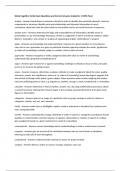
TEFL questions and answers 100% correct The Grammar-Translation method Students have to memorise grammar rules and vocabulary and practise by translating sentences from their mother tongue into the foreign language. There is little time spent developing oral skills. Direct Method or Oral method or Natural method This method advocates teaching in only the target language. This method also focuses on teaching oral skills, practice in having conversations, and improving pronunciation. Writing and reading is developed later. Grammar is learnt using the inductive approach. Audio-Lingual method This is a drilling method where a student listens and then repeats. Students practise different dialogues for different situations Structural-Situational method A model pattern is introduced and often practised with drilling. However, context is added to the scenarios. Grammatical rules are learnt one at a time. Task Based Learning With this form of learning, the students are given a task and try to work out the structure themselves. Often there is no formal instruction and students must find the solution themselves. Silent Way he teacher will say as little as possible and encourages students to create their own language, prompted by physical objects. Immersion: students are immersed in English throughout the day in school. They are taught all subjects in English. This method is often used in Asian schools. Lexical Approach In this approach, the students are taught the most commonly used lexical chunks of words and structures. The idea is that common phrases are taught Eclectic Approach all of the above teaching methods and bits from the Communicative Approach below and uses styles which suit learners at different levels. Communicative Approach Drilling is a form of repetition, getting students to repeat after you. Drilling comes from the behaviourist theorists of the 1950's who concluded that habit forming was a good way to learn a new language Drilling: Drilling is a form of repetition, getting students to repeat after you. Drilling comes from the behaviourist theorists of the 1950's who concluded that habit forming was a good way to learn a new language Intrinsic This student tells us that she does everything she can to get better at English. Her problem is that her family does not have enough money to help her Extrinsic My parents are making me come to the Extra English lessons Intrinsic This student spends her spare time organising an English Speaking club at her school Extrinsic, The school forces me to learn English Instrumental Learning English will improve your chances of finding a better job Integrative n individual has to take an English Language Test to gain citizenship in the UK true An item of language can be divided into Structural, Lexical and Phonological items to help students understand better. true One of the most straight forward ways to introduce a new item of Grammar, Lexis or Phonology is to use the Presentation-Practice-Production Technique? Adding context to structure is an essential part of adding meaning to a new item. true A Teacher must try to explain the following during a lesson: meaning The correct answer is: This method is used in a traditional setting where rules are introduced first then practised. - Deductive, In this method students practise specific dialogues for specific scenarios and drill. - Audio-Linguistic, Students spend the day learning different subjects in English. - Immersive, It's an inductive method, using target language only, focusing on oral skills and conversations. - Direct Method, Students have to memorise Grammar rules. - Grammar-Translation, Rules are worked out by students before formal instruction. - Inductive, 3 stages are used in the lesson, new rules are introduced, then an activity to practise followed by a more creative practice activity. - Present-Practice-Production ... The correct answer is: Create a Mind Map - Eliciting new vocabulary, Create a Timeline. - Showing Verb Tenses, Create a table with rules of structure. - Grammar Table, Draw a picture of different jobs. - Introducing new vocabulary, Write a word on the board showing where the emphasis should be. - Intonation ...
Written for
- Institution
- Telf
- Course
- Telf
Document information
- Uploaded on
- May 2, 2023
- Number of pages
- 7
- Written in
- 2022/2023
- Type
- Exam (elaborations)
- Contains
- Questions & answers
Subjects
-
tefl questions and answers 100 correct
-
the grammar translation method students have to memorise grammar rules and vocabulary and practise by translating sentences from their mother tongue into the fo