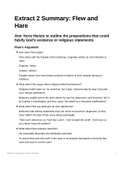
Extract 2 Summary: Flew and
Hare
Aim: force theists to outline the propositions that could
falsify God’s existence or religious statements
Flew’s Argument
How does Flew begin?
Flew starts with the Parable of the Gardener, originally written by John Wisdom in
1944
Explorer= theist
Sceptic= atheist
Parable shows how how theists continue to believe in God, despite having no
evidence
What does Flew argue about religious belief and believes?
Religious belief starts as “an assertion” but it gets “reduced step by step” and ends
up a “picture preference”
Believers qualify God to the point where he can’t be disproved, such that they “kill” it
by making it meaningless and thus cause “the death by a thousand qualifications”
What does Flew say believers do with statements?
Believers hide behind statements that can never be proved or disproved, so they
have “killed” the idea of him every being meaningful
“Take such utterances as ‘God has a plan’, ‘God created the world’, ‘God loves us
as a father loves his children’”
What does Flew reiterate/ describe?
He essentially describes the falsification principle
“to assert that such and such is the case is necessarily equivalent to denying that
such and such is not the case”
Extract 2 Summary: Flew and Hare 1
Hare
Aim: force theists to outline the propositions that could
falsify God’s existence or religious statements
Flew’s Argument
How does Flew begin?
Flew starts with the Parable of the Gardener, originally written by John Wisdom in
1944
Explorer= theist
Sceptic= atheist
Parable shows how how theists continue to believe in God, despite having no
evidence
What does Flew argue about religious belief and believes?
Religious belief starts as “an assertion” but it gets “reduced step by step” and ends
up a “picture preference”
Believers qualify God to the point where he can’t be disproved, such that they “kill” it
by making it meaningless and thus cause “the death by a thousand qualifications”
What does Flew say believers do with statements?
Believers hide behind statements that can never be proved or disproved, so they
have “killed” the idea of him every being meaningful
“Take such utterances as ‘God has a plan’, ‘God created the world’, ‘God loves us
as a father loves his children’”
What does Flew reiterate/ describe?
He essentially describes the falsification principle
“to assert that such and such is the case is necessarily equivalent to denying that
such and such is not the case”
Extract 2 Summary: Flew and Hare 1