

Chapter 4: population structure and gene flow
Genetic populations:
Panmixia versus population structure
Panmixia: random mating or ‘all mixed’ i.e. all individuals are potential partners
Population structure: non-random mating between individuals in smaller groups or
subpopulations
This leads to differences in allele and genotype frequencies between subpopulations =
genetic differentiation
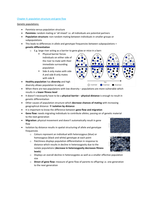
o E.g. large river acting as a barrier to gene glow or mice in a barn
Physical barrier forces
individuals on either side of
the river to mate with their
immediate surrounding
population
Side A only mates with side
A and side B only mates
with side B
Healthy population has diversity and high
diversity allows population to adjust
When there are two populations with low diversity – populations are more vulnerable which
results in a lower fitness level
It doesn’t necessarily have to be a physical barrier – physical distance is enough to result in
genetic differentiation
Other causes of population structure which decrease chances of mating with increasing
geographical distance isolation by distance
It is important to know the difference between gene flow and migration
Gene flow: needs migrating individuals to contribute alleles; passing on of genetic material
to the next generation
Migration: physical movement and doesn’t automatically result in gene
flow
Isolation by distance results in spatial structuring of allele and genotype
frequencies
o Colours represent an individual with heterozygous (blue) or
homozygous (black and white) genotype at each point
o Patchiness displays population differentiation in response to
distance which results in decline in heterozygosity due to the
isolate populations (decrease in heterozygosity decreases fitness
levels)
o Displays an overall decline in heterozygotes as well as a smaller effective population
size
o Direct of gene flow: measure of gene flow of parents to offspring i.e. one generation
to the next generation
Genetic populations:
Panmixia versus population structure
Panmixia: random mating or ‘all mixed’ i.e. all individuals are potential partners
Population structure: non-random mating between individuals in smaller groups or
subpopulations
This leads to differences in allele and genotype frequencies between subpopulations =
genetic differentiation
o E.g. large river acting as a barrier to gene glow or mice in a barn
Physical barrier forces
individuals on either side of
the river to mate with their
immediate surrounding
population
Side A only mates with side
A and side B only mates
with side B
Healthy population has diversity and high
diversity allows population to adjust
When there are two populations with low diversity – populations are more vulnerable which
results in a lower fitness level
It doesn’t necessarily have to be a physical barrier – physical distance is enough to result in
genetic differentiation
Other causes of population structure which decrease chances of mating with increasing
geographical distance isolation by distance
It is important to know the difference between gene flow and migration
Gene flow: needs migrating individuals to contribute alleles; passing on of genetic material
to the next generation
Migration: physical movement and doesn’t automatically result in gene
flow
Isolation by distance results in spatial structuring of allele and genotype
frequencies
o Colours represent an individual with heterozygous (blue) or
homozygous (black and white) genotype at each point
o Patchiness displays population differentiation in response to
distance which results in decline in heterozygosity due to the
isolate populations (decrease in heterozygosity decreases fitness
levels)
o Displays an overall decline in heterozygotes as well as a smaller effective population
size
o Direct of gene flow: measure of gene flow of parents to offspring i.e. one generation
to the next generation


