Chapter 24
Qualitative data analysis
Introduction
Main difficulty with qualitative research:
Is that is very rapidly generates a large, cumbersome database because of its
reliance on prose in the form of such media as field notes, interview transcripts or
documents
General strategies of qualitative data analysis
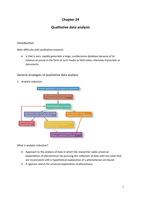
1. Analytic induction
What is analytic induction?
Approach to the analysis of data in which the researcher seeks universal
explanations of phenomenon by pursuing the collection of data until mo cases that
are inconsistent with a hypothetical explanation of a phenomenon are found
A rigorous search for universal explanation of phenomena
1
, Steps:
Rough definition of research question
Hypothetical explanation
Data collection
Examination of cases
If any deviant cases found, redefine or reformulate hypothesis
Continue until all cases fit hypothesis
Problems with analytic induction:
The final explanations that analytic induction arrives at specify the conditions that are
sufficient for the phenomenon occurring but rarely specify the necessary conditions
It doesn’t provide useful guidelines as to how many cases need to be investigated
before the absence of negative cases & the validity of the hypothetical explanation
can be confirmed
2. Grounded theory
What is grounded theory?
Theory that was derived from data, systematically gathered & analyzed through the
research process
Two central features
o Concerned with the development of theory out of data
o Approach is iterative
data collection & analysis proceed in tandem, repeatedly referring
back to each other
Repetitive interplay between data collection and analysis (or theory
building
Not a theory – it is an approach to the generation of theory out of data
Developments (Glaser & Strauss):
Straussian model more prescriptive
Term used loosely by researchers today
Straussian mode changed a great deal over the years
2
Qualitative data analysis
Introduction
Main difficulty with qualitative research:
Is that is very rapidly generates a large, cumbersome database because of its
reliance on prose in the form of such media as field notes, interview transcripts or
documents
General strategies of qualitative data analysis
1. Analytic induction
What is analytic induction?
Approach to the analysis of data in which the researcher seeks universal
explanations of phenomenon by pursuing the collection of data until mo cases that
are inconsistent with a hypothetical explanation of a phenomenon are found
A rigorous search for universal explanation of phenomena
1
, Steps:
Rough definition of research question
Hypothetical explanation
Data collection
Examination of cases
If any deviant cases found, redefine or reformulate hypothesis
Continue until all cases fit hypothesis
Problems with analytic induction:
The final explanations that analytic induction arrives at specify the conditions that are
sufficient for the phenomenon occurring but rarely specify the necessary conditions
It doesn’t provide useful guidelines as to how many cases need to be investigated
before the absence of negative cases & the validity of the hypothetical explanation
can be confirmed
2. Grounded theory
What is grounded theory?
Theory that was derived from data, systematically gathered & analyzed through the
research process
Two central features
o Concerned with the development of theory out of data
o Approach is iterative
data collection & analysis proceed in tandem, repeatedly referring
back to each other
Repetitive interplay between data collection and analysis (or theory
building
Not a theory – it is an approach to the generation of theory out of data
Developments (Glaser & Strauss):
Straussian model more prescriptive
Term used loosely by researchers today
Straussian mode changed a great deal over the years
2