The business cycle Unit 13.1. - 13.2.
Sunday, 07 August 2022 20:20
Revisions of definitions
Gross Domestic Product [GDP] is the total value of everything produced in a given period such as
a year [within the borders of the country].
GDP per capita is the average annual income, calculated as GDP divided by the number of people
in the population.
▪ GDP per capita is used as a measure of wellbeing!
Real GDP
Real GDP is nominal GDP adjusted for inflation.
Nominal GDP can increase for two reasons:
1. The amount of goods and services produced increased.
2. The amount of goods and services produced did not increase, but the prices of those goods and
services did increase [price level increase = inflation].
○ We want to know whether the economy changed in terms of actual output and therefore
we work mostly with real GDP.
○ When output changes it will influence the level of unemployment in the economy.
13.1. Growth and Fluctuations
13.2. Output growth and changes in unemployment
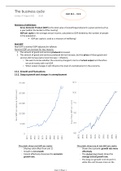
This graph shows real GDP per capita: This graph shows Log of real GDP per capita:
- [Hockey stick effect from unit 1] - Shows the economic growth rate more
- Growth is not smooth. effectively.
- Cannot effectively showcase the economic - The dashed line [slope] shows the
growth rate. average annual growth rate.
- The long-run growth: Unit 16 and 17,
while this unit focuses more on the
fluctuations.
Unit 13 Page 1
, fluctuations.
THE BUSINESS CYCLE
Economic growth is not a smooth process.
• The business cycle = alternating periods of positive and negative growth rates.
• Recession = the period when output is declining or below its potential level. Also defined as 2
consecutive quarters of negative growth in an economy.
The business cycle affects labour market outcomes.
Okun's law
Okun's law is a strong and stable relationship between unemployment and GDP growth.
Changes in the rate of GDP growth are negatively correlated with the unemployment rate.
Output falls Unemployment rises Well-being falls
Okun's coefficient is the degree of correlation.
Unit 13 Page 2
Sunday, 07 August 2022 20:20
Revisions of definitions
Gross Domestic Product [GDP] is the total value of everything produced in a given period such as
a year [within the borders of the country].
GDP per capita is the average annual income, calculated as GDP divided by the number of people
in the population.
▪ GDP per capita is used as a measure of wellbeing!
Real GDP
Real GDP is nominal GDP adjusted for inflation.
Nominal GDP can increase for two reasons:
1. The amount of goods and services produced increased.
2. The amount of goods and services produced did not increase, but the prices of those goods and
services did increase [price level increase = inflation].
○ We want to know whether the economy changed in terms of actual output and therefore
we work mostly with real GDP.
○ When output changes it will influence the level of unemployment in the economy.
13.1. Growth and Fluctuations
13.2. Output growth and changes in unemployment
This graph shows real GDP per capita: This graph shows Log of real GDP per capita:
- [Hockey stick effect from unit 1] - Shows the economic growth rate more
- Growth is not smooth. effectively.
- Cannot effectively showcase the economic - The dashed line [slope] shows the
growth rate. average annual growth rate.
- The long-run growth: Unit 16 and 17,
while this unit focuses more on the
fluctuations.
Unit 13 Page 1
, fluctuations.
THE BUSINESS CYCLE
Economic growth is not a smooth process.
• The business cycle = alternating periods of positive and negative growth rates.
• Recession = the period when output is declining or below its potential level. Also defined as 2
consecutive quarters of negative growth in an economy.
The business cycle affects labour market outcomes.
Okun's law
Okun's law is a strong and stable relationship between unemployment and GDP growth.
Changes in the rate of GDP growth are negatively correlated with the unemployment rate.
Output falls Unemployment rises Well-being falls
Okun's coefficient is the degree of correlation.
Unit 13 Page 2