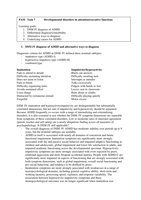
PAM Task 7 Developmental disorders in attention/executive functions
Learning goals:
1. DSM IV diagnose of ADHD
2. Differential diagnose/comorbidity
3. Alternative ways to diagnose
4. Underlying causes for ADHD
1. DSM IV diagnose of ADHD and alternative ways to diagnose
Diagnostic criteria for ADHD in DSM–IV defined three nominal subtypes:
- inattentive type (ADHD-I)
- hyperactive-impulsive type (ADHD-H)
- combined type.
Inattention Impulsivity/hyperactivity
Fails to attend to details Blurts out answers
Difficulty sustaining attention Difficulty awaiting turn
Does not seem to listen Interrupts or intrudes
Fails to finish Talks excessively
Difficulty organizing tasks Fidgets with hands or feet
Avoids sustained effort Leaves seat in classroom
Loses things Runs about or climbs
Distracted by extraneous stimuli Difficulty playing quietly
Forgetful Motor excess
DSM–IV inattention and hyperactivityimpulsivity are distinguishable but substantially
correlated dimensions, but not sure if impulsivity and hyperactivity should be separated.
Because ADHD frequently co-occurs with a range of internalizing and externalizing
disorders, it is also essential to test whether the DSM–IV symptom dimensions are separable
from symptoms of these correlated disorders. Low to moderate rates of interrater agreement
(parent, teacher and self rating) are a nearly ubiquitous finding across all measures of
psychopathology. Is DSM-IV still applicable?
- The overall diagnosis of DSM–IV ADHD has moderate stability over periods up to 9
years, but the nominal subtypes are unstable.
- ADHD in itself is associated with nearly all domains of concurrent and future
functional impairment. Inattention symptoms are significantly more strongly
associated with shy and passive social behavior and impaired adaptive functioning in
children and adolescents, global impairment and lower life satisfaction in adults, and
impaired academic functioning across the developmental spectrum. Hyperactivity-
impulsivity symptoms are more strongly associated with overt rejection by peers,
relational aggression and more frequent accidental injuries. People with ADHD-C are
significantly more impaired on aspects of functioning that are strongly associated with
both symptom dimensions, such as global impairment, overall social functioning and
pro-social behaviour, and tendency to be disliked by peers.
- Intattention symptoms are more strongly associated with weaknesses in a range of
neuropsychological domains, including general cognitive ability, short-term and
working memory, processing speed, vigilance, and response variability. The
association between hyperactivity-impulsivity symptoms and these
neuropsychological outcomes was no longer significant when inattention was
Learning goals:
1. DSM IV diagnose of ADHD
2. Differential diagnose/comorbidity
3. Alternative ways to diagnose
4. Underlying causes for ADHD
1. DSM IV diagnose of ADHD and alternative ways to diagnose
Diagnostic criteria for ADHD in DSM–IV defined three nominal subtypes:
- inattentive type (ADHD-I)
- hyperactive-impulsive type (ADHD-H)
- combined type.
Inattention Impulsivity/hyperactivity
Fails to attend to details Blurts out answers
Difficulty sustaining attention Difficulty awaiting turn
Does not seem to listen Interrupts or intrudes
Fails to finish Talks excessively
Difficulty organizing tasks Fidgets with hands or feet
Avoids sustained effort Leaves seat in classroom
Loses things Runs about or climbs
Distracted by extraneous stimuli Difficulty playing quietly
Forgetful Motor excess
DSM–IV inattention and hyperactivityimpulsivity are distinguishable but substantially
correlated dimensions, but not sure if impulsivity and hyperactivity should be separated.
Because ADHD frequently co-occurs with a range of internalizing and externalizing
disorders, it is also essential to test whether the DSM–IV symptom dimensions are separable
from symptoms of these correlated disorders. Low to moderate rates of interrater agreement
(parent, teacher and self rating) are a nearly ubiquitous finding across all measures of
psychopathology. Is DSM-IV still applicable?
- The overall diagnosis of DSM–IV ADHD has moderate stability over periods up to 9
years, but the nominal subtypes are unstable.
- ADHD in itself is associated with nearly all domains of concurrent and future
functional impairment. Inattention symptoms are significantly more strongly
associated with shy and passive social behavior and impaired adaptive functioning in
children and adolescents, global impairment and lower life satisfaction in adults, and
impaired academic functioning across the developmental spectrum. Hyperactivity-
impulsivity symptoms are more strongly associated with overt rejection by peers,
relational aggression and more frequent accidental injuries. People with ADHD-C are
significantly more impaired on aspects of functioning that are strongly associated with
both symptom dimensions, such as global impairment, overall social functioning and
pro-social behaviour, and tendency to be disliked by peers.
- Intattention symptoms are more strongly associated with weaknesses in a range of
neuropsychological domains, including general cognitive ability, short-term and
working memory, processing speed, vigilance, and response variability. The
association between hyperactivity-impulsivity symptoms and these
neuropsychological outcomes was no longer significant when inattention was