APM2613 ASSIGNMENT 1 2023
Question 1
𝑓(𝑥) = 𝑥 3 − 2𝑥 + 1
1. 𝑓(𝑥) does not have singularities or symmetries.
𝑓 is defined and continuous for all 𝑥 ∈ ℝ. Therefore, it has no singularities.
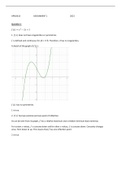
A sketch of the graph of 𝑓(𝑥):
𝑓(𝑥) has no symmetries.
1 is true.
2. 𝑓(𝑥) has two extrema and one point of inflection.
As can be seen from its graph, 𝑓 has a relative maximum and a relative minimum (two extrema).
For certain 𝑥-values, 𝑓 is concave down and for other 𝑥-values, 𝑓 is concave down. Concavity changes
once, from down to up. This means that 𝑓 has one inflection point.
2 is true.
Question 1
𝑓(𝑥) = 𝑥 3 − 2𝑥 + 1
1. 𝑓(𝑥) does not have singularities or symmetries.
𝑓 is defined and continuous for all 𝑥 ∈ ℝ. Therefore, it has no singularities.
A sketch of the graph of 𝑓(𝑥):
𝑓(𝑥) has no symmetries.
1 is true.
2. 𝑓(𝑥) has two extrema and one point of inflection.
As can be seen from its graph, 𝑓 has a relative maximum and a relative minimum (two extrema).
For certain 𝑥-values, 𝑓 is concave down and for other 𝑥-values, 𝑓 is concave down. Concavity changes
once, from down to up. This means that 𝑓 has one inflection point.
2 is true.