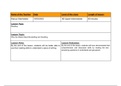
Name of the Teacher Date Level of the class Length of lesson
Elanya Oberholster 14/03/2023 B2 Upper-intermediate 60 minutes
Lesson Type:
Reading
Lesson Topic:
Why Our Brains Need Storytelling and Doodling
Lesson Aims: Lesson Outcomes:
By the end of the lesson, students will be better able to By the end of the lesson, students will have demonstrated their
use their reading skills to understand a piece of writing. comprehension and discussion skills by reading the text ,
answering questions in worksheets and groupwork.
, Anticipated difficulties: Suggested solutions:
1. Students might struggle with going from reading for 1. I will provide assistance and notes on the differences
gist to reading for detail. between the two forms of reading.
2. Students may not be familiar with specific words in 2. I will let them use dictionaries to look up the words
the reading text. and make notes.
3. Some students may understand the reading text 3. I will monitor the students throughout the lesson and
better and advance faster than other students. provide students who struggle with the text
assistance.
Authentic Text (insert reading text here or link to the listening recording)
Why Our Brains Need Storytelling and Doodling
Since the moment ancient humans began communicating with one another in meaningful ways, we (as humans)have been
storytellers. For our entire history, we have been trying to understand who we are as a species and What our role is in the greater
narrative of our existence. Our ability to tell stories has been central to this process. Our very survival has depended on it.
As social creatures.We rely on our ability to tell stories in order to help us convey our experiences to others. We can use them to
examine our lives from different perspectives and imagine possible explanations for situations we don't understand.They also
help us understand the motivations of other people and explain their reactions. Human culture, in general, is one massively
elaborate, millennia-long narrative about how we relate to one another, to nature and to the unknown. It shouldn't come as a
Elanya Oberholster 14/03/2023 B2 Upper-intermediate 60 minutes
Lesson Type:
Reading
Lesson Topic:
Why Our Brains Need Storytelling and Doodling
Lesson Aims: Lesson Outcomes:
By the end of the lesson, students will be better able to By the end of the lesson, students will have demonstrated their
use their reading skills to understand a piece of writing. comprehension and discussion skills by reading the text ,
answering questions in worksheets and groupwork.
, Anticipated difficulties: Suggested solutions:
1. Students might struggle with going from reading for 1. I will provide assistance and notes on the differences
gist to reading for detail. between the two forms of reading.
2. Students may not be familiar with specific words in 2. I will let them use dictionaries to look up the words
the reading text. and make notes.
3. Some students may understand the reading text 3. I will monitor the students throughout the lesson and
better and advance faster than other students. provide students who struggle with the text
assistance.
Authentic Text (insert reading text here or link to the listening recording)
Why Our Brains Need Storytelling and Doodling
Since the moment ancient humans began communicating with one another in meaningful ways, we (as humans)have been
storytellers. For our entire history, we have been trying to understand who we are as a species and What our role is in the greater
narrative of our existence. Our ability to tell stories has been central to this process. Our very survival has depended on it.
As social creatures.We rely on our ability to tell stories in order to help us convey our experiences to others. We can use them to
examine our lives from different perspectives and imagine possible explanations for situations we don't understand.They also
help us understand the motivations of other people and explain their reactions. Human culture, in general, is one massively
elaborate, millennia-long narrative about how we relate to one another, to nature and to the unknown. It shouldn't come as a