Points to consider during an interview (Police Codes and Conduct)
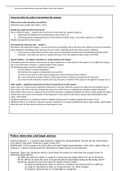
General points for police interviewing the suspect:
What are the codes the police must follow?
Interviews must comply with Codes C and E.
Should the suspect be interviewed at all?
Para 11.18(b) of code C – suspects who, at the time of the interview, appear unable to:
a. Appreciate the significance of questioning or their answers, or
b. Understand what is happening because of the effects of drink, drugs, or any illness ailment or condition.
Should not generally be interviewed.
How should the interview start - caution?
The officer will caution the suspect – you do not have to say anything. But it may harm your defence if you do not mention
when questioned something which you later rely on in court. Anything you do say may be given in evidence.
If the suspect remains silent but then raises a fact at trial which could have been mentioned during the police
interview = the court may draw an ‘adverse inference’ from the suspects silence under s34 CJPOA.
Special cautions – for objects, substances or marks found on the suspect:
If the police want the suspect to account for an object/substance or mark found on the suspect, or an object the suspect
has or was with when arrested = a special caution must be given.
The following matters must be relayed to the suspect:
(a) what offence is being investigated;
(b) what fact the suspect is being asked to account for;
(c) this fact may be due to the suspect taking part in the commission of the offence;
(d) a court may draw a proper inference if the suspect fails or refuses to account for this fact; and
(e) a record of the interview is made and it may be given in evidence if the suspect is brought to trial (para 10.11
After caution – significant statement and silences should be put to the suspect:
Code C para 11.4 states that any significant statement or silences which the suspect has made thus far should be put to
them at the start of the interview and ask the suspect to confirm/deny or anything else should be added. Should the
police officer fail to put to a suspect at the start of the interview a significant statement or silence made outside the police
station, this may result in the contents of that statement or the nature of that silence being ruled inadmissible at trial
under s 78 of PACE.
Significant statement a statement which is capable of being used as evidence against the suspect at trial
Significant silence a failure or refusal to answer a question or to answer satisfactorily when under caution, which might
allow the court to draw adverse inferences that silence at trial.
Police interview and legal advice:
General position = a suspect who requires / asked for representation should not be interviewed
until advice has been received (Code C para 6.6)
Additionally, if the suspect say they does not want legal representation, then later states they do
require it = police should stop the interview for legal advice to be obtained.
However, there are situations which could allow the police to interview the suspect prior to
obtaining legal advice:
(a) S58: the police to delay a suspect’s receiving any legal advice for up to 36 hours.
(b) An officer at least the rank of superintendent reasonably believes the delay which
would be caused by the time taken to obtain advice might:
(i) lead to interference with, or harm to, evidence connected with an offence,
(ii) lead to interference with, or physical harm to, other people,
(iii) lead to serious loss of, or damage to, property,
General points for police interviewing the suspect:
What are the codes the police must follow?
Interviews must comply with Codes C and E.
Should the suspect be interviewed at all?
Para 11.18(b) of code C – suspects who, at the time of the interview, appear unable to:
a. Appreciate the significance of questioning or their answers, or
b. Understand what is happening because of the effects of drink, drugs, or any illness ailment or condition.
Should not generally be interviewed.
How should the interview start - caution?
The officer will caution the suspect – you do not have to say anything. But it may harm your defence if you do not mention
when questioned something which you later rely on in court. Anything you do say may be given in evidence.
If the suspect remains silent but then raises a fact at trial which could have been mentioned during the police
interview = the court may draw an ‘adverse inference’ from the suspects silence under s34 CJPOA.
Special cautions – for objects, substances or marks found on the suspect:
If the police want the suspect to account for an object/substance or mark found on the suspect, or an object the suspect
has or was with when arrested = a special caution must be given.
The following matters must be relayed to the suspect:
(a) what offence is being investigated;
(b) what fact the suspect is being asked to account for;
(c) this fact may be due to the suspect taking part in the commission of the offence;
(d) a court may draw a proper inference if the suspect fails or refuses to account for this fact; and
(e) a record of the interview is made and it may be given in evidence if the suspect is brought to trial (para 10.11
After caution – significant statement and silences should be put to the suspect:
Code C para 11.4 states that any significant statement or silences which the suspect has made thus far should be put to
them at the start of the interview and ask the suspect to confirm/deny or anything else should be added. Should the
police officer fail to put to a suspect at the start of the interview a significant statement or silence made outside the police
station, this may result in the contents of that statement or the nature of that silence being ruled inadmissible at trial
under s 78 of PACE.
Significant statement a statement which is capable of being used as evidence against the suspect at trial
Significant silence a failure or refusal to answer a question or to answer satisfactorily when under caution, which might
allow the court to draw adverse inferences that silence at trial.
Police interview and legal advice:
General position = a suspect who requires / asked for representation should not be interviewed
until advice has been received (Code C para 6.6)
Additionally, if the suspect say they does not want legal representation, then later states they do
require it = police should stop the interview for legal advice to be obtained.
However, there are situations which could allow the police to interview the suspect prior to
obtaining legal advice:
(a) S58: the police to delay a suspect’s receiving any legal advice for up to 36 hours.
(b) An officer at least the rank of superintendent reasonably believes the delay which
would be caused by the time taken to obtain advice might:
(i) lead to interference with, or harm to, evidence connected with an offence,
(ii) lead to interference with, or physical harm to, other people,
(iii) lead to serious loss of, or damage to, property,