

GENETICS PRAC TEST
Prac 1:
Formulas:
C1V1= C2V2 n= m/M
C =n/v m= C x M x VC
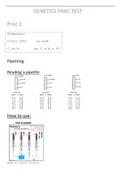
Pipetting:
Reading a pipette:
How to use:
Made by Payton Kilgour
,Centrifuge:
- RCF = relative centrifugal field (g force)
- RCF is determined by the rpm of the rotor and its
radius
- Rotor must always be balanced
- Minimum number of tubes in centrifuge is 2
Prac 2:
Genomic DNA extraction:
- To isolate DNA we have to break the cell wall and
the nuclear envelope and then remove debris
Common DNA extraction methods:
1. Phenol-chloroform DNA extraction
2. Proteinase K based extraction
3. CTAB DNA extraction
- Choosing what methos to use id based on the
quality and quantity of DNA, the sample type and
time and cost restrictions
5 Basic steps of genomic DNA extraction:
1. Cell lysis (disruption of cellular structure)
2. Separation of soluble DNA from debris and
insoluble materials
3. Precipitation of DNA
4. Washing away proteins and contaminants
5. Elution of the DNA
1. Cell lysis:
Made by Payton Kilgour
, - Release DNA into solution
- Goal is to rapidly and completely disrupt cells to
release nucleic acid
- Physical method: Grinding or crushing to disrupt
cell wall
- Chemical method: use of detergents e.g. SDS, EDTA,
Tris and chaotropes
- SDS - denatures cell membrane and nuclear
envelope, and exposes chromosomes (also releases
DNA from histones and other proteins by denaturing
them)
- Lyse buffer containing Tris and EDTA
- EDTA destabilizes the membrane, but can reduce
yield of gDNA through DNase and RNase action
- EDTA is also a chelating agent which stops the
DNase and RNase action, therefore preventing the
decrease yield of gDNA
- Tris maintains the pH of the buffer at a stable
point (usually 8.0)
- Tris also interacts with lipopolysaccharide in the
membrane which further destabilizes the membrane
- Enzymatic method: Proteinase K, collagenase and
lipase
- Proteinase K cleaves glycoproteins and inactivates
RNases and DNases
*We use a chemical and physical methos combined with
the enzyme proteinase K
2. Separation of soluble DNA from debris etc.
- Lysing cells yield contaminated solutions
- The debris needs to be removed before nucleic acid
purification
- If the debris is not removed it can interfere with
other processes
- Clearing is often accomplished using
centrifugation
Made by Payton Kilgour
Prac 1:
Formulas:
C1V1= C2V2 n= m/M
C =n/v m= C x M x VC
Pipetting:
Reading a pipette:
How to use:
Made by Payton Kilgour
,Centrifuge:
- RCF = relative centrifugal field (g force)
- RCF is determined by the rpm of the rotor and its
radius
- Rotor must always be balanced
- Minimum number of tubes in centrifuge is 2
Prac 2:
Genomic DNA extraction:
- To isolate DNA we have to break the cell wall and
the nuclear envelope and then remove debris
Common DNA extraction methods:
1. Phenol-chloroform DNA extraction
2. Proteinase K based extraction
3. CTAB DNA extraction
- Choosing what methos to use id based on the
quality and quantity of DNA, the sample type and
time and cost restrictions
5 Basic steps of genomic DNA extraction:
1. Cell lysis (disruption of cellular structure)
2. Separation of soluble DNA from debris and
insoluble materials
3. Precipitation of DNA
4. Washing away proteins and contaminants
5. Elution of the DNA
1. Cell lysis:
Made by Payton Kilgour
, - Release DNA into solution
- Goal is to rapidly and completely disrupt cells to
release nucleic acid
- Physical method: Grinding or crushing to disrupt
cell wall
- Chemical method: use of detergents e.g. SDS, EDTA,
Tris and chaotropes
- SDS - denatures cell membrane and nuclear
envelope, and exposes chromosomes (also releases
DNA from histones and other proteins by denaturing
them)
- Lyse buffer containing Tris and EDTA
- EDTA destabilizes the membrane, but can reduce
yield of gDNA through DNase and RNase action
- EDTA is also a chelating agent which stops the
DNase and RNase action, therefore preventing the
decrease yield of gDNA
- Tris maintains the pH of the buffer at a stable
point (usually 8.0)
- Tris also interacts with lipopolysaccharide in the
membrane which further destabilizes the membrane
- Enzymatic method: Proteinase K, collagenase and
lipase
- Proteinase K cleaves glycoproteins and inactivates
RNases and DNases
*We use a chemical and physical methos combined with
the enzyme proteinase K
2. Separation of soluble DNA from debris etc.
- Lysing cells yield contaminated solutions
- The debris needs to be removed before nucleic acid
purification
- If the debris is not removed it can interfere with
other processes
- Clearing is often accomplished using
centrifugation
Made by Payton Kilgour


