MECHANICS 1 EMC150S TUTORIAL 2 32 marks
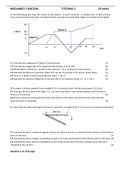
1. The following graph shows the motion of two objects – A and B. Solid line = A, dashed line = B. Both of them
start out by moving to the right, and Object B starts moving 10 seconds after Object A as shown by the graph.
38
Object B
v (m/s) 26
18
8 Object A
10 15 25 30 35 40
t (s)
-18
1.1 Calculate the magnitude of Object A’s deceleration. (1)
1.2 Calculate the magnitude of the displacement of Object A to the left. (2)
1.3 Which object is ahead (i.e.: further to the right) at t = 25 s, and by how many metres? (4)
1.4 Calculate the distance covered by Object B in the last 15 seconds of its motion shown above. (1)
1.5 How far is Object A from its starting point when t = 40 s? (2)
1.6 Calculate the velocity of Object B 25 seconds after it has started moving. (i.e.: at t = 35 s) (2)
2. An object is thrown upwards from a height of 2m. Its velocity when it strikes the ground is 11.8 m/s.
2.1 Calculate the total time for its flight. (i.e.: the time from when it was thrown upwards until the time it
returns to the ground. (5)
2.2 Draw a velocity vs time graph that shows the motion of this object. All relevant times and velocities
must be shown on the graph. (3)
3. A door 850 mm wide and hinged at point A is opened to an angle of 48° in 4.2 seconds at constant acceleration.
850 mm
A
3.1 Calculate the door’s maximum angular velocity (in rad/s) as well as its maximum linear velocity at the furthest
point on the door. (3)
3.2 Calculate the door’s angular acceleration as well as its linear acceleration at the furthest point on the door. (2)
3.3 Calculate the linear distance travelled by an ant sitting on the top of the door, halfway along. (the ant is
indicated by the red dot) (2)
Question 4 on next page
1. The following graph shows the motion of two objects – A and B. Solid line = A, dashed line = B. Both of them
start out by moving to the right, and Object B starts moving 10 seconds after Object A as shown by the graph.
38
Object B
v (m/s) 26
18
8 Object A
10 15 25 30 35 40
t (s)
-18
1.1 Calculate the magnitude of Object A’s deceleration. (1)
1.2 Calculate the magnitude of the displacement of Object A to the left. (2)
1.3 Which object is ahead (i.e.: further to the right) at t = 25 s, and by how many metres? (4)
1.4 Calculate the distance covered by Object B in the last 15 seconds of its motion shown above. (1)
1.5 How far is Object A from its starting point when t = 40 s? (2)
1.6 Calculate the velocity of Object B 25 seconds after it has started moving. (i.e.: at t = 35 s) (2)
2. An object is thrown upwards from a height of 2m. Its velocity when it strikes the ground is 11.8 m/s.
2.1 Calculate the total time for its flight. (i.e.: the time from when it was thrown upwards until the time it
returns to the ground. (5)
2.2 Draw a velocity vs time graph that shows the motion of this object. All relevant times and velocities
must be shown on the graph. (3)
3. A door 850 mm wide and hinged at point A is opened to an angle of 48° in 4.2 seconds at constant acceleration.
850 mm
A
3.1 Calculate the door’s maximum angular velocity (in rad/s) as well as its maximum linear velocity at the furthest
point on the door. (3)
3.2 Calculate the door’s angular acceleration as well as its linear acceleration at the furthest point on the door. (2)
3.3 Calculate the linear distance travelled by an ant sitting on the top of the door, halfway along. (the ant is
indicated by the red dot) (2)
Question 4 on next page