Psychometrics 2.5
chapter3
Mean and median in skewed distributions
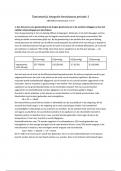
Variance-covariance matrix -the mean is always towards the tail end compared to the median.
-positively skewed means rights skew, the tail is on the right.
Percentile ranks: percentage of people with a given score or lower
-if the distribution is about normal, use z score to find the p in the table
-if the distribution is NOT normal you need to use the continuity
correction
-variance of composite score = sum all
Formula
scores of the variance-covariance matrix
(Fx)= all the people that fall onto the value or lower,
-Covariance of 2 composite scores: Xk,l & Xj,i (-0.5fx) =minus half of the people that fall on the
= sum the four in light purple highest value that we consider
Challenges of measurement:
Participant reactivity. 🡪 Participants respond differently because of their characteristics or personal circumstances
Objectivity. 🡪 there is no bias or subjectivity present
Composite score. 🡪 different parts that make up composite score may have different importance, so it can be unfair.
Score sensitivity. 🡪 different parts of scores can have different strength, different scores may also have different gravity 🡪
score delicate enough to measure differences within concept
Lack of awareness of psychometric information. 🡪 putting in stuff that isn’t relevant and can damage the test or make it
less reliable/valid
Normalized scores: to transform a non-normal variable Standardization: -turning it into a z-score
into a normal one -only works in normally distributed populations
-If you believe it is normally distributed in the population but -to compare participants among each other
you got a non-normal sample
-if however the variable is theoretically NOT assumed to be Converted standard scores/ rescaling: T-scores
normal, you should not try to normalize the scores! -are used to make z-scores more understandable
Normalization transformation
1. Calculate the percentile ranks
2. Convert them into standard scores by calculating the z scores for the percentile ranks
Chapter 4
Exploratory Factor analysis: it look for sets of items that have strong intercorrelations (that "go together")
A test can be...
Unidimensional tests: all items of a test measure Eigenvalues: how well is factor 1 able to
Unidimensional the same psychological attribute explain the total variance? The higher the
-one composite score eigenvalue, the better the factor is at
-have Conceptual homogeneity: test items have explaining variance (- > distance of dots to
Multidimensional with this property, it means that responses to each item line is small)
uncorrelated dimensions are only affected by the same psychological Factor scores: summarizing a person's
attribute score on all 3 items to just one score, often
Multidimensional with Simple structure: Each item loads mainly on one decsribed as a standardized score (like z)
correlated dimensions of the factors with SD 1 and mean 0
Factor loading: is the correlation between an
dimension = factor
item and its factor - the higher it is, the more
variance is explained (-1 to 1)
chapter3
Mean and median in skewed distributions
Variance-covariance matrix -the mean is always towards the tail end compared to the median.
-positively skewed means rights skew, the tail is on the right.
Percentile ranks: percentage of people with a given score or lower
-if the distribution is about normal, use z score to find the p in the table
-if the distribution is NOT normal you need to use the continuity
correction
-variance of composite score = sum all
Formula
scores of the variance-covariance matrix
(Fx)= all the people that fall onto the value or lower,
-Covariance of 2 composite scores: Xk,l & Xj,i (-0.5fx) =minus half of the people that fall on the
= sum the four in light purple highest value that we consider
Challenges of measurement:
Participant reactivity. 🡪 Participants respond differently because of their characteristics or personal circumstances
Objectivity. 🡪 there is no bias or subjectivity present
Composite score. 🡪 different parts that make up composite score may have different importance, so it can be unfair.
Score sensitivity. 🡪 different parts of scores can have different strength, different scores may also have different gravity 🡪
score delicate enough to measure differences within concept
Lack of awareness of psychometric information. 🡪 putting in stuff that isn’t relevant and can damage the test or make it
less reliable/valid
Normalized scores: to transform a non-normal variable Standardization: -turning it into a z-score
into a normal one -only works in normally distributed populations
-If you believe it is normally distributed in the population but -to compare participants among each other
you got a non-normal sample
-if however the variable is theoretically NOT assumed to be Converted standard scores/ rescaling: T-scores
normal, you should not try to normalize the scores! -are used to make z-scores more understandable
Normalization transformation
1. Calculate the percentile ranks
2. Convert them into standard scores by calculating the z scores for the percentile ranks
Chapter 4
Exploratory Factor analysis: it look for sets of items that have strong intercorrelations (that "go together")
A test can be...
Unidimensional tests: all items of a test measure Eigenvalues: how well is factor 1 able to
Unidimensional the same psychological attribute explain the total variance? The higher the
-one composite score eigenvalue, the better the factor is at
-have Conceptual homogeneity: test items have explaining variance (- > distance of dots to
Multidimensional with this property, it means that responses to each item line is small)
uncorrelated dimensions are only affected by the same psychological Factor scores: summarizing a person's
attribute score on all 3 items to just one score, often
Multidimensional with Simple structure: Each item loads mainly on one decsribed as a standardized score (like z)
correlated dimensions of the factors with SD 1 and mean 0
Factor loading: is the correlation between an
dimension = factor
item and its factor - the higher it is, the more
variance is explained (-1 to 1)