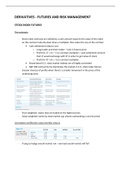
DERIVATIVES - FUTURES AND RISK MANAGEMENT
STOCK INDEX FUTURES
The contracts
- Stock-index contracts are settled by a cash amount equal to the value of the index
on the contract maturity date times a multiplier that scales the size of the contract
• Cash settlement reduces cost
o Long trader and short trader – lock in futures price
o Profit for LT = (ST – F0) x contract multiplier = cash settlement amount
that LT would exchange with ST in order to get value of stock
o Profit for ST = (F0 – ST) x contract multiplier
• Broad-based U.S. stock market indexes are all highly correlated
• S&P 500 contract by far dominates the market in U.S. stock index futures
- Greater chances of profits when there’s a smaller movement in the price of the
underlying asset
- Price weighted: stocks that are traded at the highest prices
- Value weighted: works by total market cap (shares outstanding x current price)
Correlation coefficients using monthly returns
- Trying to hedge overall market risk – worried overall market will fall
, Creating synthetic stock positions: asset allocation tool
- One reason stock-index futures are so popular is that they can substitute for
holdings in the underlying stocks themselves (i.e., “synthetic” holdings)
• Transaction costs of buying and selling futures positions are much lower than
taking spot positions
• Very popular among “market timers”
- Higher the beta – more sensitive P/L are to dips in overall market
EXAMPLE: SYNTHETIC POSITIONS USING STOCK-INDEX FUTURES
Index arbitrage
- Index arbitrage is an investment strategy that exploits divergences between actual
futures prices and their theoretically correct parity values to make a profit
• If the futures price is too high, short the futures contract and buy the stocks in
the index
• If the futures price is too low, buy futures and short the stocks
STOCK INDEX FUTURES
The contracts
- Stock-index contracts are settled by a cash amount equal to the value of the index
on the contract maturity date times a multiplier that scales the size of the contract
• Cash settlement reduces cost
o Long trader and short trader – lock in futures price
o Profit for LT = (ST – F0) x contract multiplier = cash settlement amount
that LT would exchange with ST in order to get value of stock
o Profit for ST = (F0 – ST) x contract multiplier
• Broad-based U.S. stock market indexes are all highly correlated
• S&P 500 contract by far dominates the market in U.S. stock index futures
- Greater chances of profits when there’s a smaller movement in the price of the
underlying asset
- Price weighted: stocks that are traded at the highest prices
- Value weighted: works by total market cap (shares outstanding x current price)
Correlation coefficients using monthly returns
- Trying to hedge overall market risk – worried overall market will fall
, Creating synthetic stock positions: asset allocation tool
- One reason stock-index futures are so popular is that they can substitute for
holdings in the underlying stocks themselves (i.e., “synthetic” holdings)
• Transaction costs of buying and selling futures positions are much lower than
taking spot positions
• Very popular among “market timers”
- Higher the beta – more sensitive P/L are to dips in overall market
EXAMPLE: SYNTHETIC POSITIONS USING STOCK-INDEX FUTURES
Index arbitrage
- Index arbitrage is an investment strategy that exploits divergences between actual
futures prices and their theoretically correct parity values to make a profit
• If the futures price is too high, short the futures contract and buy the stocks in
the index
• If the futures price is too low, buy futures and short the stocks