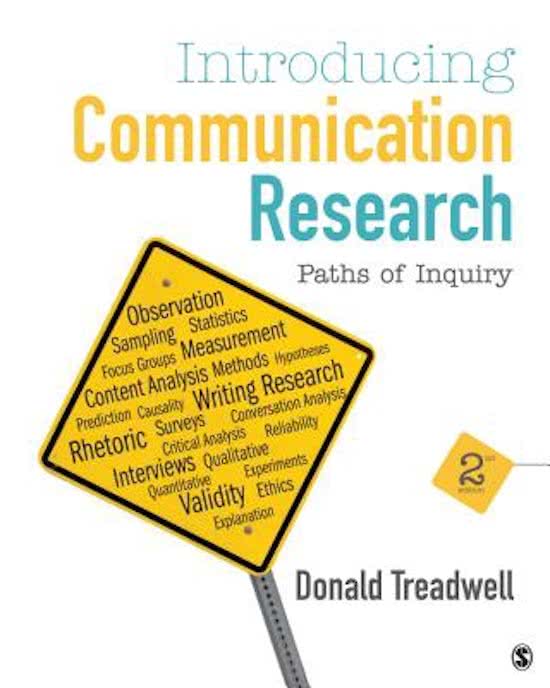
Introducing Communication Research
Donald Treadwell
Chapter 1 – getting started: possibilities and decisions
Getting started in research
Any research project requires that you start by getting yourself oriented toward
an area of interest and then deciding what questions, assumptions, and methods
will best get you the answers to your interest questions
Potential topics for research in human communication are all around us after
finding questions of interest, you have to decide how best to get an answer to
these questions (research methods) assumptions and decisions will help you
prefer some methods over others
Basic assumptions behind communication research
There are several basic assumptions that underpin all communication research:
- What we choose to look at tells us something about an underlying reality
we cannot see, but assume to exist e.g. no one has ever seen an attitude,
what we see is a person behaving in a particular way
- Theories about human behavior can be generalized there is an
assumption that people are similar in the way they behave
- The researcher’s level of engagement with his or her research
participants
- The type of purpose or reason that should underlie the research
- Some aspects of a question are more important to look at than others and,
related, that there is one best standpoint from which to observe human
communication
model of human communication (Shannon & Weaver, 1949)
o Source: the provider or initiator of content
o Message(s): the content of communication
o Channel or medium: the vehicle for communication content
e.g. social media
o Receiver(s): the recipients or consumers of information
o Noise: extraneous information or physical noise that can disrupt
an interaction
, Some research possibilities: what can we do with an ad?
Advertisements are targeted communications designed specially to motivate
consumers or institutions to purchase (usually) an advertised product or service
communication researchers could be interested in answering a number of
questions about this process:
- Does the advertisement work?
One way of access an advertisement’s effectiveness is to take a scientific
approach
two characteristics of scientific method:
o Observation (empiricism)
o The attempt to rule out alternative explanations
- What can readers and viewers tell us?
o Survey: ask questions the researcher thinks are important
quantitative results
o Focus groups: capture opinions that consumers think are
important qualitative results
- What can the content tell us?
There are many angles from which to study media content
o Rhetoric: rhetoricians are essentially interested in the appeals the
advertisement uses to persuade consumers to use the product
(qualitative)
Aristotle’s theory: search for appeals in:
Logos: logic
Ethos: character
Pathos: emotion
Kenneth Burke analyzed human communication in terms of
drama: dramatism
Describe the domestic setting, the people in it, and the mini-
drama
Argue that the scene is media advertising the parties, the
drama, the purpose
o Content analysis: quantitative method for assessing media
content based on counting content analysts might set up
categories of content based on their research interests content
analyst looks for what is explicit and observable
o Critical analysis: works from a basic assumption that
communication maintains and promotes power structures in
society the focus is on the relationship, explicit or implied,
between message source and recipient rather than just one
component of the communication process critical analyst may
look as much for what is implicit or unsaid
- What can the creators of the ad tell us?
Interested in finding out how and why decisions about content and
production were made
Donald Treadwell
Chapter 1 – getting started: possibilities and decisions
Getting started in research
Any research project requires that you start by getting yourself oriented toward
an area of interest and then deciding what questions, assumptions, and methods
will best get you the answers to your interest questions
Potential topics for research in human communication are all around us after
finding questions of interest, you have to decide how best to get an answer to
these questions (research methods) assumptions and decisions will help you
prefer some methods over others
Basic assumptions behind communication research
There are several basic assumptions that underpin all communication research:
- What we choose to look at tells us something about an underlying reality
we cannot see, but assume to exist e.g. no one has ever seen an attitude,
what we see is a person behaving in a particular way
- Theories about human behavior can be generalized there is an
assumption that people are similar in the way they behave
- The researcher’s level of engagement with his or her research
participants
- The type of purpose or reason that should underlie the research
- Some aspects of a question are more important to look at than others and,
related, that there is one best standpoint from which to observe human
communication
model of human communication (Shannon & Weaver, 1949)
o Source: the provider or initiator of content
o Message(s): the content of communication
o Channel or medium: the vehicle for communication content
e.g. social media
o Receiver(s): the recipients or consumers of information
o Noise: extraneous information or physical noise that can disrupt
an interaction
, Some research possibilities: what can we do with an ad?
Advertisements are targeted communications designed specially to motivate
consumers or institutions to purchase (usually) an advertised product or service
communication researchers could be interested in answering a number of
questions about this process:
- Does the advertisement work?
One way of access an advertisement’s effectiveness is to take a scientific
approach
two characteristics of scientific method:
o Observation (empiricism)
o The attempt to rule out alternative explanations
- What can readers and viewers tell us?
o Survey: ask questions the researcher thinks are important
quantitative results
o Focus groups: capture opinions that consumers think are
important qualitative results
- What can the content tell us?
There are many angles from which to study media content
o Rhetoric: rhetoricians are essentially interested in the appeals the
advertisement uses to persuade consumers to use the product
(qualitative)
Aristotle’s theory: search for appeals in:
Logos: logic
Ethos: character
Pathos: emotion
Kenneth Burke analyzed human communication in terms of
drama: dramatism
Describe the domestic setting, the people in it, and the mini-
drama
Argue that the scene is media advertising the parties, the
drama, the purpose
o Content analysis: quantitative method for assessing media
content based on counting content analysts might set up
categories of content based on their research interests content
analyst looks for what is explicit and observable
o Critical analysis: works from a basic assumption that
communication maintains and promotes power structures in
society the focus is on the relationship, explicit or implied,
between message source and recipient rather than just one
component of the communication process critical analyst may
look as much for what is implicit or unsaid
- What can the creators of the ad tell us?
Interested in finding out how and why decisions about content and
production were made