Political Science - Workgroup
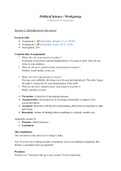
A Rulebook for Arguments
Session 1: Introduction to the course
General info:
➢ Assignment 1: 40% (Deadline: Monday 21/11, 09.00)
➢ Assignment 2: 40% (Deadline: Friday 16/12, 12.00)
➢ Participation: 20%
Construction of arguments:
1. What’s the role of persuasion in politics?
Persuasion is not always rational argumentation. You need to tailor what you say,
write, to your audience.
2. What are the most common means of persuasion in politics?
Debates, social media, events, etc.
1. What’s the role of persuasion in science?
Proving your credibility, allowing you to be read and reproduced. They don’t argue
for right or wrong, but for your interpretation of the truth.
2. What are the most common means of persuasion in politics?
Books, journals, reviews.
➢ Persuasion: Action/fact of persuading someone.
➢ Argumentation: Action/process of reasoning systemically in support of an
action/idea/theory.
➢ Argument: Reason(s) with the aim of persuading others that an action/idea is right
and wrong.
➢ Reasoning: Actions of thinking about something in a logical, sensible way.
Arguments consist of:
1. Premises, which lead up to
2. Conclusion.
The conclusion:
The conclusion is the point you’re trying to make.
Note: If you’re not working towards a conclusion, you’re not making an argument. But
beware: a conclusion isn’t an argument!
Premises:
Premises are “statements that give your reasons” for the conclusion.
A Rulebook for Arguments
Session 1: Introduction to the course
General info:
➢ Assignment 1: 40% (Deadline: Monday 21/11, 09.00)
➢ Assignment 2: 40% (Deadline: Friday 16/12, 12.00)
➢ Participation: 20%
Construction of arguments:
1. What’s the role of persuasion in politics?
Persuasion is not always rational argumentation. You need to tailor what you say,
write, to your audience.
2. What are the most common means of persuasion in politics?
Debates, social media, events, etc.
1. What’s the role of persuasion in science?
Proving your credibility, allowing you to be read and reproduced. They don’t argue
for right or wrong, but for your interpretation of the truth.
2. What are the most common means of persuasion in politics?
Books, journals, reviews.
➢ Persuasion: Action/fact of persuading someone.
➢ Argumentation: Action/process of reasoning systemically in support of an
action/idea/theory.
➢ Argument: Reason(s) with the aim of persuading others that an action/idea is right
and wrong.
➢ Reasoning: Actions of thinking about something in a logical, sensible way.
Arguments consist of:
1. Premises, which lead up to
2. Conclusion.
The conclusion:
The conclusion is the point you’re trying to make.
Note: If you’re not working towards a conclusion, you’re not making an argument. But
beware: a conclusion isn’t an argument!
Premises:
Premises are “statements that give your reasons” for the conclusion.