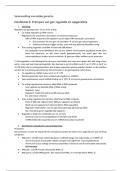
Microeconomics: Asymmetric Information
—> asymmetric information:
- The lemons problem with examples
- The mechanism that mitigates lemons problem
—> adverse selection :
- Mitigating adverse selection in insurance
—> moral hazard :
- graphical approach with marginal bene t and marginal costs
- Lessening moral hazard
- Asymmetric information in a principal-agent relationship + example
- Signaling: education example —> mathematical and graphical approach
fi
, --> asymmetric information: a situation where there is an imbalance of information
across participants in an economic transaction
--> complete information: all market participants know everything important for
making decisions
• The lemons problem and adverse selection
◦ Lemon problem: asymmetric information problem that occurs when a
seller knows more about the quality of the good he is selling than the
buyer
◦ Observable quality VS. Unobservable quality: customers know that half
of the cars are new and half are not --> 50% chance that the car is a plum
(high quality) and 50% that the car is a lemon (low quality)
• So their WTP = (Price lemon * 0.5 + Price plum * 0.5) -->
anything more will be worse off in expectation
• Buyers can't sell good cars (plum) at this price and customers
know that that means sellers can only sell lemons and customers
know that --> NO CARS WILL BE BOUGHT
◦ Adverse selection: a situation where there are stronger incentives for “bad”
types of a product to be involved in a transaction than “good” types of the
product
• This asymmetry leads to poor-quality goods being disproportionately put
up for sale
▪ The average quality of items that are offered for sale is lower than
the average quality of all such items, including those not for sale
• The average value of used cars to buyers was $5,000, but
the average value of those offered for sale was $0
◦ information asymmetry harms the less-informed participants and those who
have more information !!
◦ Examples of the lemons problem
• quality of workmanship
• used capital goods sales
• Workers
—> asymmetric information:
- The lemons problem with examples
- The mechanism that mitigates lemons problem
—> adverse selection :
- Mitigating adverse selection in insurance
—> moral hazard :
- graphical approach with marginal bene t and marginal costs
- Lessening moral hazard
- Asymmetric information in a principal-agent relationship + example
- Signaling: education example —> mathematical and graphical approach
fi
, --> asymmetric information: a situation where there is an imbalance of information
across participants in an economic transaction
--> complete information: all market participants know everything important for
making decisions
• The lemons problem and adverse selection
◦ Lemon problem: asymmetric information problem that occurs when a
seller knows more about the quality of the good he is selling than the
buyer
◦ Observable quality VS. Unobservable quality: customers know that half
of the cars are new and half are not --> 50% chance that the car is a plum
(high quality) and 50% that the car is a lemon (low quality)
• So their WTP = (Price lemon * 0.5 + Price plum * 0.5) -->
anything more will be worse off in expectation
• Buyers can't sell good cars (plum) at this price and customers
know that that means sellers can only sell lemons and customers
know that --> NO CARS WILL BE BOUGHT
◦ Adverse selection: a situation where there are stronger incentives for “bad”
types of a product to be involved in a transaction than “good” types of the
product
• This asymmetry leads to poor-quality goods being disproportionately put
up for sale
▪ The average quality of items that are offered for sale is lower than
the average quality of all such items, including those not for sale
• The average value of used cars to buyers was $5,000, but
the average value of those offered for sale was $0
◦ information asymmetry harms the less-informed participants and those who
have more information !!
◦ Examples of the lemons problem
• quality of workmanship
• used capital goods sales
• Workers