SILVERTHORN
CHAPTER 19 – THE KIDNEYS
FUNCTION OF THE KIDNEYS
The most important function of the kidney is the homeostatic regulation of the water and ion content
of the blood, or also called the salt and water balance or fluid and electrolyte balance. The functions
of the kidney can be divided in 6 general areas:
– Regulation of extracellular fluid volume and blood pressure
o decrease in extracellular fluid volume is related to a decrease in blood pressure
– Regulation of osmolarity (290 mOsM)
– Maintenance of ion balance
– Homeostatic regulation of pH
– Excretion of wastes
– Production of hormones
o Synthesize erythropoietin (EPO)
o Release of renin
ANATOMY OF THE URINARY SYSTEM
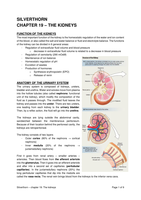
The urinary system is composed of kidneys, ureters,
bladder and urethra. Water and solutes move from plasma
into the hollow tubules (also called nephrons: functional
unit of the kidney), which modify the composition of the
fluid as it passes through. The modified fluid leaves the
kidney and passes into the ureter. There are two ureters,
one leading from each kidney to the urinary bladder.
Then, by a reflex action, the fluid will go into the urethra.
The kidneys are lying outside the abdominal cavity,
sandwiched between the membranous peritoneum.
Because of their location behind the peritoneal cavity, the
kidneys are retroperitoneal.
The kidney consists of two layers
– Outer cortex (80% of the nephrons cortical
nephrons)
– Inner medulla (20% of the nephrons
juxtamedullary nephrons)
First it goes from renal artery – smaller arteries –
arterioles. Then blood flows from the afferent arteriole
into the glomerulus. Then it goes into an efferent arteriole
and after into a second set of capillaries (peritubular
capillaries). In the juxtamedullary nephrons (20%) the
long peritubular capillaries that dip into the medulla are
called the vasa recta. The renal vein brings blood from the kidneys to the inferior vena cava.
Silverthorn – chapter 19: The kidneys Page 1 of 9
CHAPTER 19 – THE KIDNEYS
FUNCTION OF THE KIDNEYS
The most important function of the kidney is the homeostatic regulation of the water and ion content
of the blood, or also called the salt and water balance or fluid and electrolyte balance. The functions
of the kidney can be divided in 6 general areas:
– Regulation of extracellular fluid volume and blood pressure
o decrease in extracellular fluid volume is related to a decrease in blood pressure
– Regulation of osmolarity (290 mOsM)
– Maintenance of ion balance
– Homeostatic regulation of pH
– Excretion of wastes
– Production of hormones
o Synthesize erythropoietin (EPO)
o Release of renin
ANATOMY OF THE URINARY SYSTEM
The urinary system is composed of kidneys, ureters,
bladder and urethra. Water and solutes move from plasma
into the hollow tubules (also called nephrons: functional
unit of the kidney), which modify the composition of the
fluid as it passes through. The modified fluid leaves the
kidney and passes into the ureter. There are two ureters,
one leading from each kidney to the urinary bladder.
Then, by a reflex action, the fluid will go into the urethra.
The kidneys are lying outside the abdominal cavity,
sandwiched between the membranous peritoneum.
Because of their location behind the peritoneal cavity, the
kidneys are retroperitoneal.
The kidney consists of two layers
– Outer cortex (80% of the nephrons cortical
nephrons)
– Inner medulla (20% of the nephrons
juxtamedullary nephrons)
First it goes from renal artery – smaller arteries –
arterioles. Then blood flows from the afferent arteriole
into the glomerulus. Then it goes into an efferent arteriole
and after into a second set of capillaries (peritubular
capillaries). In the juxtamedullary nephrons (20%) the
long peritubular capillaries that dip into the medulla are
called the vasa recta. The renal vein brings blood from the kidneys to the inferior vena cava.
Silverthorn – chapter 19: The kidneys Page 1 of 9