JASP EXAM
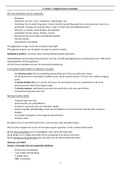
1. CHECK IF THE DATA IS CORRECT
Descriptives -> frequencies: place variables in the right box.
Statistics: select mean, SD, Minimum, Maximum.
For missing values: preferences -> data, leave them empty or write NaN.
2. MEASUREMENT LEVEL
3. CORRELATIONS
Relations between two variables.
Pearson: scale variables.
Spearman: nominal and ordinal variables.
Phi – coefficient: nominal variables.
Regression -> correlation -> items to be correlated in the right table.
Check: Pearson’s r, report significance, flag significant correlations, display pairwise (scatter
plots).
, Report: (r = t-value, p = Sig. (2-tailed)).
Report: (r: .86, p < .001)
Report text: The results show a strong correlation between the reading- and calculus scores
(r = .75, p = .01). Good readers are generally also good in calculus, and in general weak
readers are not good in calculus as well. The scores of reading and world orientation are not
correlated (r = .06, p = .86), neither are the scores on calculus and world orientation (r = -
.51, p = .13).
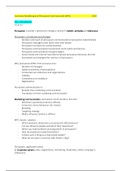
4. RELIABILITY
Indication about to what extent the raters measure the same thing.
Reliability -> single test reliability.
Check: Cronbach Alpha, if item dropped, item rest correlation.
Value: 0.7 to be reliable.
If reliability increases when one rater is dropped, create an average table.
Report: The reliability analysis indicates that the five questions on comprehensibility
measure the same construct (α = .94). The same applies to the five questions about the
appeal of the instructions (α = .96). Therefore, was decided to calculate an average score
over the five questions for both constructs.
1. CHECK IF THE DATA IS CORRECT
Descriptives -> frequencies: place variables in the right box.
Statistics: select mean, SD, Minimum, Maximum.
For missing values: preferences -> data, leave them empty or write NaN.
2. MEASUREMENT LEVEL
3. CORRELATIONS
Relations between two variables.
Pearson: scale variables.
Spearman: nominal and ordinal variables.
Phi – coefficient: nominal variables.
Regression -> correlation -> items to be correlated in the right table.
Check: Pearson’s r, report significance, flag significant correlations, display pairwise (scatter
plots).
, Report: (r = t-value, p = Sig. (2-tailed)).
Report: (r: .86, p < .001)
Report text: The results show a strong correlation between the reading- and calculus scores
(r = .75, p = .01). Good readers are generally also good in calculus, and in general weak
readers are not good in calculus as well. The scores of reading and world orientation are not
correlated (r = .06, p = .86), neither are the scores on calculus and world orientation (r = -
.51, p = .13).
4. RELIABILITY
Indication about to what extent the raters measure the same thing.
Reliability -> single test reliability.
Check: Cronbach Alpha, if item dropped, item rest correlation.
Value: 0.7 to be reliable.
If reliability increases when one rater is dropped, create an average table.
Report: The reliability analysis indicates that the five questions on comprehensibility
measure the same construct (α = .94). The same applies to the five questions about the
appeal of the instructions (α = .96). Therefore, was decided to calculate an average score
over the five questions for both constructs.