PO382 Producer-Consumer Linkage and Politicisation
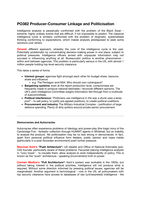
Intelligence analysis is perpetually confronted with the problem of the Black Swan -
extreme, highly unlikely events that are difficult, if not impossible to predict. The classical
intelligence cycle is similarly confronted with the problem of dogmatic, systematised
thinking conforming to expectations, which makes analysts predisposed to seek some
solutions over others.
Omand: different approach, whereby the core of the intelligence cycle is the user.
Potentially problematic by concentrating decision-making power in one place, subject to
political pressures. Intelligence officers armed with unpopular information may not
succeed in influencing anything at all. Bureaucratic politics is another phenomenon -
within and between agencies. This problem is particularly serious in the US, with almost 1
million people holding top-level security clearance.
This takes a series of forms:
Interest groups: agencies fight amongst each other for budget share, resource
share and influence
e.g. The Pentagon and NSA. Who should own cyberspace?
Bargaining systems: even at the report production level, compromises are
frequently made to produce national estimates / reconcile different opinions. The
UK’s Joint Intelligence Committee weighs information fed through from a multitude
of subcommittees.
Political interference: “Politicians use intelligence in the way a drunk uses a lamp-
post” - to sell policy, to justify pre-agreed positions, to create political coalitions.
Procurement and industry: The Military-Industrial Complex - justification of large
defence spending. Plenty of dirty politics around private sector procurement.
Democracies and Autocracies
Autocracies often experience problems of ideology and power-play (the tragic irony of the
Cambridge Five - fantastic collection through HUMINT agents in Whitehall, but an inability
to analyse the product). Yet politicisation may be no less strong in democracies. In fact,
apart from personal political influence form leaders, public opinion and mass media
(particularly in a post-Snowden environment) exert further pressure.
Sherman Kent's "Push Arhitecture": US idealist and Office of National Estimates (pre-
CIA) founder, particularly aware of these problems. Favoured placing intelligence analysts
in "ivory tower" - to insulate them; allow analysis to exist independently of policy. This is
known as the “push” architecture - speaking (inconvenient) truth to power.
Carmen Medina's "Pull Architecture": Kent's system was workable in the 1950s, but
without taking interest in the political priorities, intelligence will not produce what is
required. Without some direction informed by pressing political issues, agencies will be
marginalised. Another argument is technological - now in the US, all policymakers with
top security clearance have access to databases of raw (uninterpreted) intelligence - the
Intelligence analysis is perpetually confronted with the problem of the Black Swan -
extreme, highly unlikely events that are difficult, if not impossible to predict. The classical
intelligence cycle is similarly confronted with the problem of dogmatic, systematised
thinking conforming to expectations, which makes analysts predisposed to seek some
solutions over others.
Omand: different approach, whereby the core of the intelligence cycle is the user.
Potentially problematic by concentrating decision-making power in one place, subject to
political pressures. Intelligence officers armed with unpopular information may not
succeed in influencing anything at all. Bureaucratic politics is another phenomenon -
within and between agencies. This problem is particularly serious in the US, with almost 1
million people holding top-level security clearance.
This takes a series of forms:
Interest groups: agencies fight amongst each other for budget share, resource
share and influence
e.g. The Pentagon and NSA. Who should own cyberspace?
Bargaining systems: even at the report production level, compromises are
frequently made to produce national estimates / reconcile different opinions. The
UK’s Joint Intelligence Committee weighs information fed through from a multitude
of subcommittees.
Political interference: “Politicians use intelligence in the way a drunk uses a lamp-
post” - to sell policy, to justify pre-agreed positions, to create political coalitions.
Procurement and industry: The Military-Industrial Complex - justification of large
defence spending. Plenty of dirty politics around private sector procurement.
Democracies and Autocracies
Autocracies often experience problems of ideology and power-play (the tragic irony of the
Cambridge Five - fantastic collection through HUMINT agents in Whitehall, but an inability
to analyse the product). Yet politicisation may be no less strong in democracies. In fact,
apart from personal political influence form leaders, public opinion and mass media
(particularly in a post-Snowden environment) exert further pressure.
Sherman Kent's "Push Arhitecture": US idealist and Office of National Estimates (pre-
CIA) founder, particularly aware of these problems. Favoured placing intelligence analysts
in "ivory tower" - to insulate them; allow analysis to exist independently of policy. This is
known as the “push” architecture - speaking (inconvenient) truth to power.
Carmen Medina's "Pull Architecture": Kent's system was workable in the 1950s, but
without taking interest in the political priorities, intelligence will not produce what is
required. Without some direction informed by pressing political issues, agencies will be
marginalised. Another argument is technological - now in the US, all policymakers with
top security clearance have access to databases of raw (uninterpreted) intelligence - the