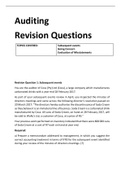
Auditing
Revision Questions
TOPICS COVERED: Subsequent events
Going Concern
Evaluation of Misstatements
Revision Question 1: Subsequent events
You are the auditor of Coca (Pty) Ltd (Coca), a large company which manufactures
carbonated drinks with a year-end 28 February 2017.
As part of your subsequent events review in April, you inspected the minutes of
directors meetings and came across the following director’s resolution passed on
20 March 2017: “The directors hereby authorise the discontinuance of Soda Cream
as they believe it is an immaterial line of business. Soda Cream is a carbonated drink
manufactured by Coca. All cans of Soda Cream, on hand at 28 February 2017, will
be sold to Wolly’s Ltd, a customer of Coca, at a price of R5.”
Your previous work performed on inventory indicated that there were 800 000 cans
of Soda Cream at a cost of R7 each on hand at year end.
Required:
a) Prepare a memorandum addressed to management, in which you suggest the
correct accounting treatment in terms of IFRS for the subsequent event identified
during your review of the minutes of directors meetings. (7)
, b) Assuming management has accounted for the subsequent event as an adjusting
event, provide the audit procedures you would perform to audit the accounting of
the subsequent event. (8)
a) Prepare a memorandum addressed to management, in which you suggest
the correct accounting treatment in terms of IFRS for the subsequent event
identified during your review of the minutes of directors meetings. (7)
Memorandum
To: Management
From: Auditor
Subject: Accounting treatment of subsequent events
Date: April 2017 (2)
The decision is an event after reporting date as the resolution was passed
on 20 March 2017, and year end is 28 February 2017. (1)
Two types of events after reporting date exist, namely those that provide
evidence of conditions that existed at reporting date (adjusting), and
those that are indicative of conditions that arose after the reporting
period (non-adjusting). (1)
Although the decision to discontinue Soda Cream and sell the inventory
on hand took place after year end, the selling price post year end provides
evidence of the value of Soda Cream inventory at year end. (1)
Inventory should be valued at the lower of cost and net realisable value
(NRV) which is estimated selling price less costs to sell. (1)
The selling price post year end, provides evidence that the NRV (R5) of
Soda Cream inventory is lower than the cost (R7), therefore the inventory
adjustment is an adjusting event. (1)
Soda Cream inventory is thus overvalued at year end (800 000 x 2= R 1
600 000), and thus Soda Cream inventory should be written down to its
NRV at year end as follows: (1)
Dr Inventory Adjustment (P/L) 1 600 000
Revision Questions
TOPICS COVERED: Subsequent events
Going Concern
Evaluation of Misstatements
Revision Question 1: Subsequent events
You are the auditor of Coca (Pty) Ltd (Coca), a large company which manufactures
carbonated drinks with a year-end 28 February 2017.
As part of your subsequent events review in April, you inspected the minutes of
directors meetings and came across the following director’s resolution passed on
20 March 2017: “The directors hereby authorise the discontinuance of Soda Cream
as they believe it is an immaterial line of business. Soda Cream is a carbonated drink
manufactured by Coca. All cans of Soda Cream, on hand at 28 February 2017, will
be sold to Wolly’s Ltd, a customer of Coca, at a price of R5.”
Your previous work performed on inventory indicated that there were 800 000 cans
of Soda Cream at a cost of R7 each on hand at year end.
Required:
a) Prepare a memorandum addressed to management, in which you suggest the
correct accounting treatment in terms of IFRS for the subsequent event identified
during your review of the minutes of directors meetings. (7)
, b) Assuming management has accounted for the subsequent event as an adjusting
event, provide the audit procedures you would perform to audit the accounting of
the subsequent event. (8)
a) Prepare a memorandum addressed to management, in which you suggest
the correct accounting treatment in terms of IFRS for the subsequent event
identified during your review of the minutes of directors meetings. (7)
Memorandum
To: Management
From: Auditor
Subject: Accounting treatment of subsequent events
Date: April 2017 (2)
The decision is an event after reporting date as the resolution was passed
on 20 March 2017, and year end is 28 February 2017. (1)
Two types of events after reporting date exist, namely those that provide
evidence of conditions that existed at reporting date (adjusting), and
those that are indicative of conditions that arose after the reporting
period (non-adjusting). (1)
Although the decision to discontinue Soda Cream and sell the inventory
on hand took place after year end, the selling price post year end provides
evidence of the value of Soda Cream inventory at year end. (1)
Inventory should be valued at the lower of cost and net realisable value
(NRV) which is estimated selling price less costs to sell. (1)
The selling price post year end, provides evidence that the NRV (R5) of
Soda Cream inventory is lower than the cost (R7), therefore the inventory
adjustment is an adjusting event. (1)
Soda Cream inventory is thus overvalued at year end (800 000 x 2= R 1
600 000), and thus Soda Cream inventory should be written down to its
NRV at year end as follows: (1)
Dr Inventory Adjustment (P/L) 1 600 000