Summary IGCSE Economics 0455 Notes (Chapter 1-2) For 2023
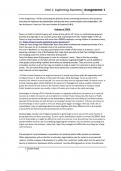
IGCSE Economics 0455 Notes (Chapter 1-2) For 2023. Need ⇒ goods or services necessary for survival Want ⇒ goods or services NOT necessary for survival Finite resources ⇒ resources that will eventually run out Renewable resources ⇒ resources that can be replaced as they are used to produce goods or services The economic problem ⇒ limited resources and unlimited wants which leads to a problem called scarcity Scarcity ⇒ an economic problem where the resources are not enough to satisfy unlimited wants Economic goods ⇒ goods which are scarce relative to the demand for them Free goods ⇒ goods which are supplied at zero cost and are enough available relative to the demand for them 1.2 Factors of production ⇒ land, labor, capital, enterprise Land - natural resources Labor - human resources Capital - manufactured resources Enterprise - the skill which brings all the other factors together in order for production to happen Mobility of factors of production ⇒ how easy or difficult it is for FOP to be transferred to alternative industries 1.3 Opportunity cost ⇒ the next best alternative foregone when making an economic decision 1.4 Production Possibility Curve (PPC) ⇒ shows the maximum possible output for two goods or services with a given amount of resources Straight - constant opportunity cost Curve - not constant opportunity cost The point INSIDE the curve shows an inefficient usage of resources The point OUTSIDE the curve is an unobtainable output. It can only be obtained if there is an increase in the resources used for production (FOP) 2.1 Microeconomics ⇒ the study of the economic behavior of an individual or businesses (small scale) E.g. a person, business, etc Macroeconomics ⇒ the study of the whole economy (large scale) E.g. the government, etc 2.2 Market ⇒ a place where many buyers and sellers meet to exchange goods or services for money Market economy ⇒ an economy where only the buyers and sellers determine the price without intervention by the government Planned economy ⇒ an economy where all decisions including production, investment, prices, and incomes are determined by the government Price mechanism ⇒ a system which enables buyers and sellers to trade goods and services at an agreed price Market equilibrium ⇒ when quantity demanded is the same as the quantity supplied Equilibrium price ⇒ the price at which the quantity the buyers want to buy is equal to the quantity the sellers are prepared to sell Market disequilibrium ⇒ where the quantity demanded and the quantity supplied are not equal Allocation of resources ⇒ the way resources are allocated to the production of the goods and services most wanted by consumers The price mechanism answers the questions: - What to produce? The product that is most wanted by consumers - How to produce? Lowest cost to make the selling price remain competitive - For whom to produce? High wages for employees -> able to buy products and services Low wages for employees -> unable to buy products and services
Connected book
- 2014
- 9781107612365
- Unknown
Written for
- Institution
- IGCSE Economics
- Course
- IGCSE Economics
Document information
- Summarized whole book?
- Yes
- Uploaded on
- January 7, 2023
- Number of pages
- 23
- Written in
- 2022/2023
- Type
- Summary
Subjects
-
igcse economics
-
economics
-
igcse
-
igcse economics 0455 notes chapter 1 2
-
igcse economics 0455 notes chapter 1 2 for 2023
-
igcse economics 0455 notes