100% satisfaction guarantee Immediately available after payment Both online and in PDF No strings attached 4.2 TrustPilot
logo-home
Other

Operating System Concepts 10th Edition by Abraham Silberschatz, Gagne and Peter Galvin. All Chapters 1-17 | TEST BANK

Rating
-
Sold
7
Pages
194
Uploaded on
24-12-2022
Written in
2022/2023

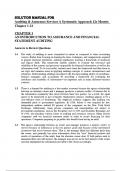
TEST BANK for Operating System Concepts, 10th Edition ISBN: by Abraham Silberschatz, Greg Gagne and Peter B. Galvin. All Chapters 1-17 (Complete Download). TABLE OF CONTENTS CHAP TER 1: Introduction 1.1 What Operating Systems Do 1.2 Computer-System Organization 1.3 Computer-System Architecture 1.4 Operating-System Operations 1.5 Resource Management 1.6 Security and Protection 1.7 Virtualization 1.8 Distributed Systems 1.9 Kernel Data Structures 1.10 Computing Environments 1.11 Free and Open-Source Operating Systems 1.12 CHAPTER 2: Operating-System Structures 2.1 Operating-System Services 2.2 User and Operating-System Interface 2.3 System Calls 2.4 System Services 2.5 Linkers and Loaders 2.6 Why Applications Are Operating-System Specific 2.7 Operating-System Design and Implementation 2.8 Operating-System Structure 2.9 Building and Booting an Operating System 2.10 Operating-System Debugging 2.11 Programming Problems Programming Projects PART TWO: PROCESS MANAGEMENT CHAPTER 3: Processes 3.1 Process Concept 3.2 Process Scheduling 3.3 Operations on Processes 3.4 Interprocess Communication 3.5 IPC in Shared-Memory Systems 3.6 IPC in Message-Passing Systems 3.7 Examples of IPC Systems 3.8 Communication in Client–Server Systems 3.9 Programming Problems Programming Projects CHAPTER 4: Threads & Concurrency 4.1 Overview 4.2 Multicore Programming 4.3 Multithreading Models 4.4 Thread Libraries 4.5 Implicit Threading 4.6 Threading Issues 4.7 Operating-System Examples 4.8 Programming Problems Programming Projects CHAPTER 5: CPU Scheduling 5.1 Basic Concepts 5.2 Scheduling Criteria 5.3 Scheduling Algorithms 5.4 Thread Scheduling 5.5 Multi-Processor Scheduling 5.6 Real-Time CPU Scheduling 5.7 Operating-System Examples 5.8 Algorithm Evaluation 5.9 Programming Projects PART THREE: PROCESS SYNCHRONIZATION CHAPTER 6: Synchronization Tools 6.1 Background 6.2 The Critical-Section Problem 6.3 Peterson's Solution 6.4 Hardware Support for Synchronization 6.5 Mutex Locks 6.6 Semaphores 6.7 Monitors 6.8 Liveness 6.9 Evaluation 6.10 Programming Problems CHAPTER 7: Synchronization Examples 7.1 Classic Problems of Synchronization 7.2 Synchronization within the Kernel 7.3 POSIX Synchronization 7.4 Synchronization in Java 7.5 Alternative Approaches 7.6 Programming Problems Programming Projects CHAPTER 8: Deadlocks 8.1 System Model 8.2 Deadlock in Multithreaded Applications 8.3 Deadlock Characterization 8.4 Methods for Handling Deadlocks 8.5 Deadlock Prevention 8.6 Deadlock Avoidance 8.7 Deadlock Detection 8.8 Recovery from Deadlock 8.9 Programming Problems Programming Projects PART FOUR: MEMORY MANAGEMENT CHAPTER 9: Main Memory 9.1 Background 9.2 Contiguous Memory Allocation 9.3 Paging 9.4 Structure of the Page Table 9.5 Swapping 9.6 Example: Intel 32- and 64-bit Architectures 9.7 Example: ARMv8 Architecture 9.8 Programming Problems Programming Projects CHAPTER 10: Virtual Memory 10.1 Background 10.2 Demand Paging 10.3 Copy-on-Write 10.4 Page Replacement 10.5 Allocation of Frames 10.6 Thrashing 10.7 Memory Compression 10.8 Allocating Kernel Memory 10.9 Other Considerations 10.10 Operating-System Examples 10.11 Programming Problems Programming Projects PART FIVE: STORAGE MANAGEMENT CHAPTER 11: Mass-Storage Structure 11.1 Overview of Mass-Storage Structure 11.2 HDD Scheduling 11.3 NVM Scheduling 11.4 Error Detection and Correction 11.5 Storage Device Management 11.6 Swap-Space Management 11.7 Storage Attachment 11.8 RAID Structure Programming Problems CHAPTER 12: I/O Systems 12.1 Overview 12.2 I/O Hardware 12.3 Application I/O Interface 12.4 Kernel I/O Subsystem 12.5 Transforming I/O Requests to Hardware Operations 12.6 STREAMS 12.7 Performance PART SIX: FILE SYSTEM CHAPTER 13: File-System Interface 13.1 File Concept 13.2 Access Methods 13.3 Directory Structure 13.4 Protection 13.5 Memory-Mapped Files CHAPTER 14: File-System Implementation 14.1 File-System Structure 14.2 File-System Operations 14.3 Directory Implementation 14.4 Allocation Methods 14.5 Free-Space Management 14.6 Efficiency and Performance 14.7 Recovery 14.8 Example: The WAFL File System Programming Problems CHAPTER 15: File-System Internals 15.1 File Systems 15.2 File-System Mounting 15.3 Partitions and Mounting 15.4 File Sharing 15.5 Virtual File Systems 15.6 Remote File Systems 15.7 Consistency Semantics 15.8 NFS PART SEVEN: SECURITY AND PROTECTION CHAPTER 16: Security 16.1 The Security Problem 16.2 Program Threats 16.3 System and Network Threats 16.4 Cryptography as a Security Tool 16.5 User Authentication 16.6 Implementing Security Defenses 16.7 An Example: Windows 10 Summary Exercises CHAPTER 17: Protection 17.1 Goals of Protection 17.2 Principles of Protection 17.3 Protection Rings 17.4 Domain of Protection 17.5 Access Matrix 17.6 Implementation of the Access Matrix 17.7 Revocation of Access Rights 17.8 Role-Based Access Control 17.9 Mandatory Access Control (MAC) 17.10 Capability-Based Systems 17.11 Other Protection Improvement Methods 17.12 Language-Based Protection PART EIGHT: ADVANCED TOPICS

Show more Read less
Institution
Operating System Concepts
Course
Operating System Concepts


Whoops! We can’t load your doc right now. Try again or contact support.

Connected book

Written for

Institution
Operating System Concepts
Course
Operating System Concepts

Document information

Uploaded on
December 24, 2022
Number of pages
194
Written in
2022/2023
Type
Other
Person
Unknown

Subjects

Content preview

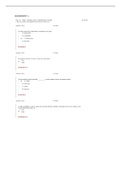
,Chapter 1


Multiple Choice Questions

1. In what way is an operating system like a government?
A) It seldom functions correctly.
B) It creates an environment within which other programs can do useful work.
C) It performs most useful functions by itself.
D) It is always concerned primarily with the individual's needs.

Ans: B
Section 1.1
Difficulty: Easy


2. Which of the following components of a computer system defines the ways to use system
resources to solve computing problems?
A) application programs
B) operating system
C) computer hardware
D) computer logo

Ans: A
Difficulty: Easy
Feedback: 1.1


3. ____ operating systems are designed primarily to maximize resource utilization.
A) PC
B) Handheld computer
C) Mainframe
D) Network

Ans: C
Feedback: 1.1.1
Difficulty: Easy


1

,4. Which of the following programs runs all the time on the computer?
A) compiler
B) assembler
C) text editor
D) kernel

Ans: D
Difficulty: Easy
Feedback: 1.1.3


5. Which of the following will trigger an interrupt?
A) kernel function
B) software execution
C) CPU execution
D) I/O completion

Ans: D
Difficulty: Easy
Feedback: 1.2.1


6. Which of the following is NOT secondary storage device?
A) random access memory
B) solid state disks
C) optical disk
D) magnetic tape

Ans: A
Difficulty: Easy
Feedback: 1.2.2


7. Which of the following contains the addresses of all the service routines?
A) page table
B) interrupt vector
C) system call table
D) file descriptor table

Ans: B
Difficulty: Easy
Feedback: 1.2.1.1


2

, 8. Which of the following stage triggers the CPU switch from user program to interrupt
processing?
A) I/O request
B) transfer done
C) interrupt signaled
D) interrupt handled

Ans: C
Difficulty: Medium
Feedback: 1.2.1.1


9. The device controller _____ an interrupt by asserting a signal on the
interrupt request line.
A) raises
B) catches
C) dispatches
D) clears

Ans: A
Difficulty: Easy
Feedback: 1.2.1.2


10. The CPU catches the interrupt and ____ it to the interrupt handler
A) raises
B) catches
C) dispatches
D) clears

Ans: C
Difficulty: Easy
Feedback: 1.2.1.2


11. Which of the following clears the interrupt by servicing the device?
A) interrupt request line
B) interrupt-controller hardware
C) interrupt vector
D) interrupt service routine

Ans: D
Difficulty: Medium
Feedback: 1.2.1.1


3

Get to know the seller

Seller avatar
Reputation scores are based on the amount of documents a seller has sold for a fee and the reviews they have received for those documents. There are three levels: Bronze, Silver and Gold. The better the reputation, the more your can rely on the quality of the sellers work.
AcademiContent Aalborg University
Follow You need to be logged in order to follow users or courses
Sold
3053
Member since
6 year
Number of followers
2132
Documents
1236
Last sold
1 hour ago

4,0

386 reviews

5
203
4
84
3
38
2
17
1
44

Recently viewed by you

Why students choose Stuvia

Created by fellow students, verified by reviews

Quality you can trust: written by students who passed their exams and reviewed by others who've used these notes.

Didn't get what you expected? Choose another document

No worries! You can immediately select a different document that better matches what you need.

Pay how you prefer, start learning right away

No subscription, no commitments. Pay the way you're used to via credit card or EFT and download your PDF document instantly.

Student with book image

“Bought, downloaded, and aced it. It really can be that simple.”

Alisha Student

Frequently asked questions