Research Methods and Statistics
W1.1
CHAPTER 1 – PSYCHOLOGY IS A WAY OF THINKING
Research producer = Psychologist that intends to write up results and present them at research
meetings
Research consumer = Psychologist that intends to read about scientific research and apply it
to their work
Empiricism: Involves using evidence from the senses or from instruments that assist the
senses as the basis for conclusions – Systematic, rigorous and independently verifiable →
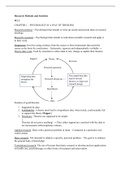
Theory-data cycle: Used by scientists to collect data to test, change or update their theories
Support Theory
Revision
Research questions
Supporting data Non-supporting data
strengthen the Research design lead to revised
theory theories or improved
research design
Hypotheses
Data
Features of good theories:
1. Supported by data
2. Falsifiability: A theory must lead to a hypothesis that, when tested, could actually fail
to support the theory (Popper)
3. Parsimony: Theories are supposed to be simple
↓
Theories do not prove anything! → They either support/are consisted with the data or
are inconsistent with/complicate a theory
Applied research: Done with a practical problem in mind – Conducted in a particular real-
world context
Basic research: Not intended to address a specific, practical problem – The goal is to enhance
the general body of knowledge
Translational research: The use of lessons from basic research to develop and test applications
on health care, psychotherapy or other forms of treatment and intervention
, CHAPTER 2 – SOURCES OF INFORMATION: WHY RESEARCH IS THE BEST AND
HOW TO FIND IT
Research vs. personal experience:
- Personal experience has no comparison group
- Evidence derived from personal experience is confounded (= it is uncertain what the
cause of the change that is researched is) – There is no carefully controlled
environment in which the experiment takes place
↓
- Research is probabilistic (= its findings are not expected to explain all cases all of the
time)
Research vs. intuition:
- Intuition is biased
- We tend to believe good stories
- Availability heuristics: The things that pop up easily in our minds tend to guide
our thinking
- Present/present bias: Our failure to consider appropriate comparison groups
- Confirmation bias: We tend to only look at information that agrees with what
we already believe in
- Bias blind spot: The belief that we are unlikely to fall prey to bias
Induction
The empirical cycle:
Observation
Theory
Deduction
Evaluation
Results Prediction
Testing
Rules of science:
1. Openness
2. Thoroughness – Going through the entire empirical cycle
3. Honesty
W1.1
CHAPTER 1 – PSYCHOLOGY IS A WAY OF THINKING
Research producer = Psychologist that intends to write up results and present them at research
meetings
Research consumer = Psychologist that intends to read about scientific research and apply it
to their work
Empiricism: Involves using evidence from the senses or from instruments that assist the
senses as the basis for conclusions – Systematic, rigorous and independently verifiable →
Theory-data cycle: Used by scientists to collect data to test, change or update their theories
Support Theory
Revision
Research questions
Supporting data Non-supporting data
strengthen the Research design lead to revised
theory theories or improved
research design
Hypotheses
Data
Features of good theories:
1. Supported by data
2. Falsifiability: A theory must lead to a hypothesis that, when tested, could actually fail
to support the theory (Popper)
3. Parsimony: Theories are supposed to be simple
↓
Theories do not prove anything! → They either support/are consisted with the data or
are inconsistent with/complicate a theory
Applied research: Done with a practical problem in mind – Conducted in a particular real-
world context
Basic research: Not intended to address a specific, practical problem – The goal is to enhance
the general body of knowledge
Translational research: The use of lessons from basic research to develop and test applications
on health care, psychotherapy or other forms of treatment and intervention
, CHAPTER 2 – SOURCES OF INFORMATION: WHY RESEARCH IS THE BEST AND
HOW TO FIND IT
Research vs. personal experience:
- Personal experience has no comparison group
- Evidence derived from personal experience is confounded (= it is uncertain what the
cause of the change that is researched is) – There is no carefully controlled
environment in which the experiment takes place
↓
- Research is probabilistic (= its findings are not expected to explain all cases all of the
time)
Research vs. intuition:
- Intuition is biased
- We tend to believe good stories
- Availability heuristics: The things that pop up easily in our minds tend to guide
our thinking
- Present/present bias: Our failure to consider appropriate comparison groups
- Confirmation bias: We tend to only look at information that agrees with what
we already believe in
- Bias blind spot: The belief that we are unlikely to fall prey to bias
Induction
The empirical cycle:
Observation
Theory
Deduction
Evaluation
Results Prediction
Testing
Rules of science:
1. Openness
2. Thoroughness – Going through the entire empirical cycle
3. Honesty