Public policy: an introduction to the field
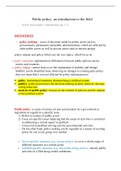
- Knil & Tosun chapter 1 (Introduction), pp. 1-12.
DEFINITIONS
- policy making= series of decisions made by public actors such as
governments, parliaments and public administrations, which are affected by
other public actors as well as private actors such as interest groups
policy outputs and policy effects are the core topics, which focus on
o policy variation: explanation of differences between public policies across
sectors and countries
o policy change: central focus is on the explanation of stability and change.
Stability can be benefitial since observing no changes to existing pulic policy
does not mean that it was not affected by policy making process
polity: institutional structures characterizing a political system
politics: political processes, the decision making eg.party political cleavage,
voting behaviour
analysis of public policy: focuses on the content of policies and the outputs
of the political system
Public policy: a course of action (or non action) taken by a government or
legislature in regards to a specific issue
1) Refers to actions of public actors
2) Focus on specific issues implying that the scope of activities is restricted
to addressing a certain aspect or problem
- Conceived as problem solving activity-governmental activities
- On the other hand, policy making can be regarded as a means of exerting
power by one social group over another
a. Sector-specific measures (e.g. energy policy): to cover a whole range of
different measures in a certain sector
b. Subfield-specific measures (e.g. renewable energy policy): classify public
activities in a filed along certain subthemes
- Knil & Tosun chapter 1 (Introduction), pp. 1-12.
DEFINITIONS
- policy making= series of decisions made by public actors such as
governments, parliaments and public administrations, which are affected by
other public actors as well as private actors such as interest groups
policy outputs and policy effects are the core topics, which focus on
o policy variation: explanation of differences between public policies across
sectors and countries
o policy change: central focus is on the explanation of stability and change.
Stability can be benefitial since observing no changes to existing pulic policy
does not mean that it was not affected by policy making process
polity: institutional structures characterizing a political system
politics: political processes, the decision making eg.party political cleavage,
voting behaviour
analysis of public policy: focuses on the content of policies and the outputs
of the political system
Public policy: a course of action (or non action) taken by a government or
legislature in regards to a specific issue
1) Refers to actions of public actors
2) Focus on specific issues implying that the scope of activities is restricted
to addressing a certain aspect or problem
- Conceived as problem solving activity-governmental activities
- On the other hand, policy making can be regarded as a means of exerting
power by one social group over another
a. Sector-specific measures (e.g. energy policy): to cover a whole range of
different measures in a certain sector
b. Subfield-specific measures (e.g. renewable energy policy): classify public
activities in a filed along certain subthemes