THE MEDIA + ADDICTION
AO1-
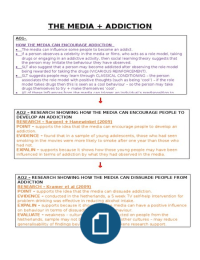
HOW THE MEDIA CAN ENCOURAGE ADDICTION
The media can influence some people to become an addict.
If a person observes a celebrity in the media or films, who acts as a role model, taking
drugs or engaging in an addictive activity, then social learning theory suggests that
the person may imitate the behaviour they have observed.
SLT also suggest that a person may become addicted after observing the role model
being rewarded for taking the drugs (VICARIOUS REINFORCEMENT).
SLT suggests people may learn through CLASSICAL CONDITIONING – the person
associates the role model with positive thoughts (such as being ‘cool’) – if the role
model takes drugs then this is seen as a cool behaviour – so the person may take
drugs themselves to try + make themselves ‘cool’.
All of these influences from the media can trigger an individual’s predisposition to
↓
AO2 – RESEARCH SHOWING HOW THE MEDIA CAN ENCOURAGE PEOPLE TO
DEVELOP AN ADDICTION
RESEARCH – Sargent + Hanewinkel (2009)
POINT – supports the idea that the media can encourage people to develop an
addiction.
EVIDENCE – found that in a sample of young adolescents, those who had seen
smoking in the movies were more likely to smoke after one year than those who
had not.
EXPALIN – supports because it shows how those young people may have been
influenced in terms of addiction by what they had observed in the media.
EVALUATE – weakness – issue of correlation + causation – don’t know it was the
↓
AO2 – RESEARCH SHOWING HOW THE MEDIA CAN DISSUADE PEOPLE FROM
ADDICTION
RESEARCH – Kramer et al (2009)
POINT – supports the idea that the media can dissuade addiction.
EVIDENCE – conducted in the Netherlands, a 5 week TV self-help intervention for
problem drinking was effective in reducing alcohol intake.
EXPALIN – supports because it shows how the media can have a positive influence
on behaviour in terms of dissuading addictive behaviour.
EVALUATE – weakness – culture bias – only conducted on people from the
Netherlands, sample may not be representative of other cultures – may reduce
generalisability of findings beyond the study – weakens research support.
AO1-
HOW THE MEDIA CAN ENCOURAGE ADDICTION
The media can influence some people to become an addict.
If a person observes a celebrity in the media or films, who acts as a role model, taking
drugs or engaging in an addictive activity, then social learning theory suggests that
the person may imitate the behaviour they have observed.
SLT also suggest that a person may become addicted after observing the role model
being rewarded for taking the drugs (VICARIOUS REINFORCEMENT).
SLT suggests people may learn through CLASSICAL CONDITIONING – the person
associates the role model with positive thoughts (such as being ‘cool’) – if the role
model takes drugs then this is seen as a cool behaviour – so the person may take
drugs themselves to try + make themselves ‘cool’.
All of these influences from the media can trigger an individual’s predisposition to
↓
AO2 – RESEARCH SHOWING HOW THE MEDIA CAN ENCOURAGE PEOPLE TO
DEVELOP AN ADDICTION
RESEARCH – Sargent + Hanewinkel (2009)
POINT – supports the idea that the media can encourage people to develop an
addiction.
EVIDENCE – found that in a sample of young adolescents, those who had seen
smoking in the movies were more likely to smoke after one year than those who
had not.
EXPALIN – supports because it shows how those young people may have been
influenced in terms of addiction by what they had observed in the media.
EVALUATE – weakness – issue of correlation + causation – don’t know it was the
↓
AO2 – RESEARCH SHOWING HOW THE MEDIA CAN DISSUADE PEOPLE FROM
ADDICTION
RESEARCH – Kramer et al (2009)
POINT – supports the idea that the media can dissuade addiction.
EVIDENCE – conducted in the Netherlands, a 5 week TV self-help intervention for
problem drinking was effective in reducing alcohol intake.
EXPALIN – supports because it shows how the media can have a positive influence
on behaviour in terms of dissuading addictive behaviour.
EVALUATE – weakness – culture bias – only conducted on people from the
Netherlands, sample may not be representative of other cultures – may reduce
generalisability of findings beyond the study – weakens research support.