EKN 120
Chapter 16: Government and Market Failure
Market failure: A situation in which a market, left on its own, fails to allocate resources
efficiently
The government intervene in the market to correct the market failures and promote the general
welfare of the people
Cost benefit Analysis
Cost benefit analysis: A method that compares the costs and benefits to society of providing a
public good
The government uses CBA to decide whether to provide a public good. It should provide a public
good if total benefits to society outweigh the costs
Public Choice theory
Market failures which implode economic efficiency, justify government interventions in the
economy
Public choice theory is the economic analysis of government decision-making by politicians and
other civil servants who are motivated by their own interests and NOT national interest
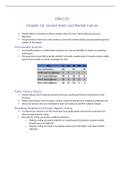
Revealing Preferences Through Majority Voting
In a democracy, decisions on which and how much public goods and services to produce are
done through majority voting
But majority voting can produce inefficient decisions
o Majority voting can lead to rejection of a public good that produce a greater public
benefit than cost (MB>MC)
o Majority voting can result in accepting a public goof with higher costs than benefits
(MB<MC)
o
, Interest Groups: People who share strong preferences for a public good may band together into
interest groups to convince others of the merits of that public good
Political logrolling: The trading of votes to secure favourable outcomes, can also turn an
inefficient outcome into an efficient one
Paradox of Voting: A situation where the outcome of majority-rule voting over a discrete set of
candidates produces a clear winner
Median Voter Theorem: States that “a majority rule” voting system will select the outcome most
preferred by the median voter
Government Failure
The inability or unwillingness of the government to act primarily in the interest of its citizens
Reasons include:
o Special interest effect: Any result of government promotion of the interests of a small
group at the expense of a much larger group
o Rent-seeking behaviour: The actions by persons, firms or unions to gain special benefits
from government at the taxpayers’ or someone else’s expense
o Favouring programs with clear benefits but hidden costs
o Limited and bundled choice of public goods that doesn’t fit the preferences of any
particular voter
o Bureaucracy and inefficiency
o Inefficient regulations and intervention
Chapter 16: Government and Market Failure
Market failure: A situation in which a market, left on its own, fails to allocate resources
efficiently
The government intervene in the market to correct the market failures and promote the general
welfare of the people
Cost benefit Analysis
Cost benefit analysis: A method that compares the costs and benefits to society of providing a
public good
The government uses CBA to decide whether to provide a public good. It should provide a public
good if total benefits to society outweigh the costs
Public Choice theory
Market failures which implode economic efficiency, justify government interventions in the
economy
Public choice theory is the economic analysis of government decision-making by politicians and
other civil servants who are motivated by their own interests and NOT national interest
Revealing Preferences Through Majority Voting
In a democracy, decisions on which and how much public goods and services to produce are
done through majority voting
But majority voting can produce inefficient decisions
o Majority voting can lead to rejection of a public good that produce a greater public
benefit than cost (MB>MC)
o Majority voting can result in accepting a public goof with higher costs than benefits
(MB<MC)
o
, Interest Groups: People who share strong preferences for a public good may band together into
interest groups to convince others of the merits of that public good
Political logrolling: The trading of votes to secure favourable outcomes, can also turn an
inefficient outcome into an efficient one
Paradox of Voting: A situation where the outcome of majority-rule voting over a discrete set of
candidates produces a clear winner
Median Voter Theorem: States that “a majority rule” voting system will select the outcome most
preferred by the median voter
Government Failure
The inability or unwillingness of the government to act primarily in the interest of its citizens
Reasons include:
o Special interest effect: Any result of government promotion of the interests of a small
group at the expense of a much larger group
o Rent-seeking behaviour: The actions by persons, firms or unions to gain special benefits
from government at the taxpayers’ or someone else’s expense
o Favouring programs with clear benefits but hidden costs
o Limited and bundled choice of public goods that doesn’t fit the preferences of any
particular voter
o Bureaucracy and inefficiency
o Inefficient regulations and intervention