EKN 120
Chapter 14: The Keynesian Cross
AD-AS Model
The AD-AS Model is a way of illustrating national income determination and changes in the
price level
It explains price level and output through the relationship of AD and AS
Movements of AD and AS curves can be used to predict the effects that various exogenous
events will have on real GDP and the price level
Why does the AD slopes downward?
o Real-balances effect
o Interest rate effect
o Foreign purchases effect
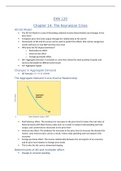
AD= Aggregate Demand: A schedule or curve that shows the total quantity of goods and
services demanded at different price levels
AS= Aggregate Supply
Changes in Aggregate Demand
AD Formula = C + I + G + (X-M)
The Aggregate Demand Curve Inverse Relationship
Real balances effect: The tendency for increases in the price level to lower the real value of
financial assets with fixed money value and, as a result, to reduce total spending and real
output, and conversely for decreases in the price level
Interest rate effect: The tendency for increases in the price level to increase the demand for
money, raise interest rates, and as a result, reduce total spending and real output in the
economy
Foreign purchase effect: The inverse relationship between the net exports of an economy
and its price level relative to foreign price levels
This is why the Ad curve is downward sloping
Determinants of AD and multiplier effect
Changes in consumer spending
Chapter 14: The Keynesian Cross
AD-AS Model
The AD-AS Model is a way of illustrating national income determination and changes in the
price level
It explains price level and output through the relationship of AD and AS
Movements of AD and AS curves can be used to predict the effects that various exogenous
events will have on real GDP and the price level
Why does the AD slopes downward?
o Real-balances effect
o Interest rate effect
o Foreign purchases effect
AD= Aggregate Demand: A schedule or curve that shows the total quantity of goods and
services demanded at different price levels
AS= Aggregate Supply
Changes in Aggregate Demand
AD Formula = C + I + G + (X-M)
The Aggregate Demand Curve Inverse Relationship
Real balances effect: The tendency for increases in the price level to lower the real value of
financial assets with fixed money value and, as a result, to reduce total spending and real
output, and conversely for decreases in the price level
Interest rate effect: The tendency for increases in the price level to increase the demand for
money, raise interest rates, and as a result, reduce total spending and real output in the
economy
Foreign purchase effect: The inverse relationship between the net exports of an economy
and its price level relative to foreign price levels
This is why the Ad curve is downward sloping
Determinants of AD and multiplier effect
Changes in consumer spending