EKN 120
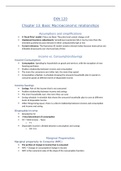
Chapter 13: Basic Macroeconomic relationships
Assumptions and simplifications
A ‘Stuck Price’ model: Prices are fixed. The price level cannot change at all
Unplanned inventory adjustments: Sometimes inventories fall or rise by more than the
intended quantity because demand is either unexpectedly high or low
Current relevance: The Keynesian AE model remains relevant today because many prices are
inflexible downwards over short periods of time
Income vs. Consumption/Savings
Income-Consumption
Consumption: Spending by households on goods and services, with the exception of new
housing purchases
Positive relationship between income and consumption
The more the consumers earn (after tax), the more they spend
Consumption schedule: A schedule showing the amounts households plan to spend on
consumer goods at different levels of disposable income
Income-Savings
Savings: Part of the income that is not consumed
Positive relationship between Income and savings
The more households earn, the more they can save
Saving schedule: A schedule that shows the amounts households plan to save at different
levels of disposable income
Other things being equal , there is a direct relationship between income and consumption
and income and saving
Disposable Income
Denoted by Yd
A key determinant of consumption
Yd = Total Income – Taxes
o Y-t
Disposable income is divided between consumption and savings
o Yd= C+S
Marginal Propensities
Marginal propensity to Consume (MPC)
The portion of change in income that is consumed
MPC = Change in Consumption/Change in Income
MPC is the numerical value of the slope of the consumption function
, Marginal Propensity to Save (MPS)
The portion of change in income that is saved
MPS = Change in Savings/Change in income
MPS is the numerical value of the slope of the savings function
MPS + MPC =1
Variable 1: C and S are determined by Yd
o C= Yd
o S= Yd-C
Variable 2: C and S is determined by MPC and MPS respectively
o C = cYd
o S = (1-c) Yd
Variable 3: C and S will finally be influenced by the exogenous consumption Co
o C = Co + cYd
o S = -Co + (1-c)Yd
Chapter 13: Basic Macroeconomic relationships
Assumptions and simplifications
A ‘Stuck Price’ model: Prices are fixed. The price level cannot change at all
Unplanned inventory adjustments: Sometimes inventories fall or rise by more than the
intended quantity because demand is either unexpectedly high or low
Current relevance: The Keynesian AE model remains relevant today because many prices are
inflexible downwards over short periods of time
Income vs. Consumption/Savings
Income-Consumption
Consumption: Spending by households on goods and services, with the exception of new
housing purchases
Positive relationship between income and consumption
The more the consumers earn (after tax), the more they spend
Consumption schedule: A schedule showing the amounts households plan to spend on
consumer goods at different levels of disposable income
Income-Savings
Savings: Part of the income that is not consumed
Positive relationship between Income and savings
The more households earn, the more they can save
Saving schedule: A schedule that shows the amounts households plan to save at different
levels of disposable income
Other things being equal , there is a direct relationship between income and consumption
and income and saving
Disposable Income
Denoted by Yd
A key determinant of consumption
Yd = Total Income – Taxes
o Y-t
Disposable income is divided between consumption and savings
o Yd= C+S
Marginal Propensities
Marginal propensity to Consume (MPC)
The portion of change in income that is consumed
MPC = Change in Consumption/Change in Income
MPC is the numerical value of the slope of the consumption function
, Marginal Propensity to Save (MPS)
The portion of change in income that is saved
MPS = Change in Savings/Change in income
MPS is the numerical value of the slope of the savings function
MPS + MPC =1
Variable 1: C and S are determined by Yd
o C= Yd
o S= Yd-C
Variable 2: C and S is determined by MPC and MPS respectively
o C = cYd
o S = (1-c) Yd
Variable 3: C and S will finally be influenced by the exogenous consumption Co
o C = Co + cYd
o S = -Co + (1-c)Yd