A
SAFe Advanced Scrum Master
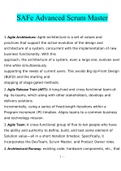
1. Agile Architecture: Agile architecture is a set of values and
practices that support the active evolution of the design and
architecture of a system, concurrent with the implementation of new
business functionality. With this
approach, the architecture of a system, even a large one, evolves over
time while simultaneously
supporting the needs of current users. This avoids Big Up-Front Design
(BUFD) and the starting and
stopping of stage-gated methods.
2. Agile Release Train (ART): A long-lived and cross-functional team-of-
Ag- ile-teams, which along with other stakeholders, develops and
delivers solutions
incrementally, using a series of fixed-length Iterations within a
Program Increment (PI) timebox. Aligns teams to a common business
and technology mission.
3. Agile Team: A cross-functional group of five to ten people who have
the ability and authority to define, build, and test some element of
Solution value—all in a short Iteration timebox. Specifically, it
incorporates the DevTeam, Scrum Master, and Product Owner roles.
4. Architectural Runway: existing code, hardware components, etc., that
,techni- cally enable near-term business features
5. Built-in Quality: Practices that ensure that each Solution element,
at every increment, meets appropriate quality standards
throughout development.
6. Business Owners: A small group of stakeholders who have the
primary busi- ness and technical responsibility for governance,
compliance, and Return on Investment for a Solution developed by an
Agile Release Train (ART). They are key stakeholders on the ART who
must evaluate fitness for use and actively participate in certain ART
events.
7. CapEx and OpEx: Capital Expenses and Operating Expenses describe
Lean-Agile financial accounting practices in a Value Stream budget. In
some cases, CapEx may include capitalized labor associate with the
development of intangible assets - such as software, intellectual
property, and patents
8.Capabilities: A higher-level solution behavior that typically spans
multiple ARTs. Capabilities are sized and split into multiple features so
that they can be imple- mented in a single PI.
9. Community of Practice (CoP): An organized group of people with
common interests in a specific technical or business domain. They
collaborate regularly to
, share information, improve their skills, and actively work on advancing
the general knowledge of the domain.
10.Compliance: A strategy and set of activities and artifacts that allow
teams to apply Lean-Agile development methods to build systems that
have the highest possible possible quality, while simultaneously
assuring they meet any regulatory, industry, or relevant standards.
11.Continuous Delivery Pipeline: CD Pipeline (also referred to as
'pipeline') rep- resents the workflows, activities, and automation
needed to provide a continuous release of value to the end user.
12.Continuous Deployment (CD): The process that takes validated
Features from Continuous Integration and deploys them into the
production environment, where they are tested and readied for
release. It is the third element in the
four-part Continuous Delivery Pipeline of Continuous Exploration (CE),
Continuous Integration (CI), Continuous Deployment, and Release on
Demand.
13.Continuous Exploration (CE): The process of constantly exploring
market and user needs, and defining a Vision, Roadmap, and set of
Features that address those needs. It is the first element in the four-
part Continuous Delivery Pipeline, preceding Continuous Integration
(CI) Continuous Deployment (CD), and Release on Demand.
14.Continuous Integration (CI): The process of taking features from the
Program Backlog and developing, testing, integrating, and validating
them in a staging environment where they are ready for deployment
SAFe Advanced Scrum Master
1. Agile Architecture: Agile architecture is a set of values and
practices that support the active evolution of the design and
architecture of a system, concurrent with the implementation of new
business functionality. With this
approach, the architecture of a system, even a large one, evolves over
time while simultaneously
supporting the needs of current users. This avoids Big Up-Front Design
(BUFD) and the starting and
stopping of stage-gated methods.
2. Agile Release Train (ART): A long-lived and cross-functional team-of-
Ag- ile-teams, which along with other stakeholders, develops and
delivers solutions
incrementally, using a series of fixed-length Iterations within a
Program Increment (PI) timebox. Aligns teams to a common business
and technology mission.
3. Agile Team: A cross-functional group of five to ten people who have
the ability and authority to define, build, and test some element of
Solution value—all in a short Iteration timebox. Specifically, it
incorporates the DevTeam, Scrum Master, and Product Owner roles.
4. Architectural Runway: existing code, hardware components, etc., that
,techni- cally enable near-term business features
5. Built-in Quality: Practices that ensure that each Solution element,
at every increment, meets appropriate quality standards
throughout development.
6. Business Owners: A small group of stakeholders who have the
primary busi- ness and technical responsibility for governance,
compliance, and Return on Investment for a Solution developed by an
Agile Release Train (ART). They are key stakeholders on the ART who
must evaluate fitness for use and actively participate in certain ART
events.
7. CapEx and OpEx: Capital Expenses and Operating Expenses describe
Lean-Agile financial accounting practices in a Value Stream budget. In
some cases, CapEx may include capitalized labor associate with the
development of intangible assets - such as software, intellectual
property, and patents
8.Capabilities: A higher-level solution behavior that typically spans
multiple ARTs. Capabilities are sized and split into multiple features so
that they can be imple- mented in a single PI.
9. Community of Practice (CoP): An organized group of people with
common interests in a specific technical or business domain. They
collaborate regularly to
, share information, improve their skills, and actively work on advancing
the general knowledge of the domain.
10.Compliance: A strategy and set of activities and artifacts that allow
teams to apply Lean-Agile development methods to build systems that
have the highest possible possible quality, while simultaneously
assuring they meet any regulatory, industry, or relevant standards.
11.Continuous Delivery Pipeline: CD Pipeline (also referred to as
'pipeline') rep- resents the workflows, activities, and automation
needed to provide a continuous release of value to the end user.
12.Continuous Deployment (CD): The process that takes validated
Features from Continuous Integration and deploys them into the
production environment, where they are tested and readied for
release. It is the third element in the
four-part Continuous Delivery Pipeline of Continuous Exploration (CE),
Continuous Integration (CI), Continuous Deployment, and Release on
Demand.
13.Continuous Exploration (CE): The process of constantly exploring
market and user needs, and defining a Vision, Roadmap, and set of
Features that address those needs. It is the first element in the four-
part Continuous Delivery Pipeline, preceding Continuous Integration
(CI) Continuous Deployment (CD), and Release on Demand.
14.Continuous Integration (CI): The process of taking features from the
Program Backlog and developing, testing, integrating, and validating
them in a staging environment where they are ready for deployment