ATI Community Health 2019 Version 2
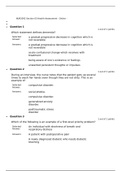
ATI Community Health 2019 Version 2 1. A home health nurse is visiting a client who has right-sided weakness following a recent stroke. The client states, “I’m not sure how I will buy my groceries since I can’t go back to work.” Which of the following actions should the nurse take? a. Provide the client information about respite care. b. Initiate a referral for the client to a social worker. c. Contact friends and neighbors to ship for the client. d. Offer to bring groceries to the client on a regular basis. 2. A case manager is performing discharge planning for a client who experienced a traumatic leg amputation and has a new prosthesis. Which of the following assessments should the nurse identify as the priority? a. Determine whether the client is eligible to go to a skilled nursing facility. b. Collaborate with a prosthetist to teach the client about care of the prosthesis. d. Ask whether the client’s insurance will cover home health services. 3. A hospice nurse is concerned that the partner of a client is experiencing caregiver burden. Which of the following actions should the nurse take first? a. Suggest an assistive personnel visit daily to provide client care. b. Encourage the partner to invite family members to assist with client care. c. Teach the partner about getting enough rest. d. Explore possible solutions with the partner. 4. A home health nurse is performing a home safety evaluation for a newly admitted client. Which of the following findings requires action by the nurse? (SATA) a. The floors of the house are carpeted. c. A red light is kept on in the bedroom at night. e. A rubber-backed bath mat is on the floor outside the shower. 5. A nurse at a health department is discussing regulations regarding STIs during a staff education session. Which of the following statements by a staff member indicates an understanding of the information? a. “Congress mandates the requirements for STI reporting.” b. “Clients who have STIs are legally required to provide a list of sexual partners.” c. “Nurses should withhold the name of the client who has an STI during partner notification.” d. “State health departments report selected STIs to the National Institutes of Health. 6. A school nurse is implementing health screenings. Which of the following assessment findings should the nurse recognize as the highest priority? a. An Adolescent who has psoriasis c. A child who has a BMI of 18 d. An adolescent who has scoliosis 7. A faith community nurse is preparing to meet with the family of an adolescent who has leukemia. Which of the following actions should the nurse plan to take? a. Focus the discussion on the adolescent’s future career plans. b. Direct communication to the parents to avoid embarrassing the adolescent. d. Ask another family from the same faith congregation to attend the meeting for support. 8. A case manager in a rehabilitation facility is discussing discharge plans with a client who has a pressure injury and requires a special bed at home. Which of the following statements should the nurse make first? a. “Apply moisture barrier ointment three times a day.” b. “Eat a balanced diet with high-protein snacks.” c. “A social worker can help you with the cost of supplies.” 9. A community health nurse encounters a client who has a suspected bioterrorism-related illness. Which of the following actions should the nurse take? a. Report the client’s condition to the Federal Bureau of Investigation. b. Move the client to a quarantine area. d. Disinfect contaminated areas of skin with isopropyl alcohol. 10. A case manager is planning home health care for a client who has a major burn injury. Which of the following interventions should the case manager plan to make? a. Deliver family counseling to members of the client’s household. b. Administer personal care with bathing, dressing, and meal preparation for the client. d. Provide physical and occupational therapy for the client in her home. 11. A community health nurse is teaching a group of older adult clients about hypertension. The nurse should identify which of the following as a client-related barrier to learning? a. Low literacy b. Fear of public speaking c. Limited experience d. Lack of credibility 12. A home health nurse is educating a client who has COPD and is to start using home oxygen via nasal cannula. Which of the following statements should the nurse identify as an indication that the client understands the teaching? a. “I should apply petroleum jelly to the nasal cannula prongs to prevent irritation.” b. “I should keep the oxygen delivery system at least 3 feet from a hearing vent.” c. “I should use wool blankets on my bed when I’m using the oxygen.” 13. A community health nurses planning an educational program for a group of women who are postmenopausal. Which of the following outcomes is appropriate for this program? a. Clients will significantly decrease caloric intake. b. Clients will arrange for mammograms every 3 years. d. Clients will start hormone replacement therapy. 14. A home health nurse is preparing to teach the family of a client who has a new diagnosis of HIV about infection control. Which of the following factors should the nurse identify as an educator-related barrier to learning? a. Reliance on written notes during the teaching session b. Previous experience teaching HIV management courses c. Use of educational materials in written and video format d. Use of humor to deal with disruptive behavior 15. A home health nurse is caring for a client who has methicillin-resistant Staphylococcus aureus. Which of the following actions should the nurse take? a. Encourage the client to use a HEPA filter in the house. b. Wear a mask when within 3 feet of the client. d. Remove fresh flowers from the client’s home. 16. A nurse is providing teaching to a newly licensed the nurse about secondary prevention strategies related to violence and abuse. Which of the following strategies should the nurse include in the teaching? b. Teach a parenting skills class at a child development center. c. Coordinate a personal defense program at a local agency. d. Refer clients to the appropriate community agency if signs of abuse are evident. 17. A school nurse is discussing stress management techniques with a group adolescents. Which of the following activities by an adolescent should the nurse identify as the priority? b. Scratching or piercing the skin c. Talking about others on social media d. Listening to loud music for several hours 18. A public health nurse is developing protocols to use in emergency shelters following a disaster. Which of the following interventions should the nurse include as a secondary prevention strategy for clients who survive a disaster? a. Publishing a listing of shelter locations in local media sources b. Providing age-appropriate activities for shelter residents c. Compiling resources available to transition individuals from shelters to a home 19. A home health nurse is discussing electrical hazards with a client. Which of the following statements should the nurse include? a. “You should limit your use of extension cords.” b. “You should secure extension cords with clear packing tape.” c. “You should pull on the cord when unplugging items.” d. “You should cover electrical cords with an area rug.” 20. A nurse is working to reduce individual and family violence in the local community. Which of the following actions by the nurse demonstrates a primary prevention strategy to achieve this goal.? a. Assessing a family for marital discord b. Conducting counseling for at-risk parents d. Providing treatment for young adult who has a substance use disorder 21. A community health nurse is teaching a group of clients about available resources to assist with recovery following a stroke. Which of the following resources should the nurse recommend for clients who are experiencing dysphagia? a. Restorative aide b. Occupational therapist c. Speech-language pathologist d. Physical therapist 22. A nurse working in an infectious disease clinic is caring for a client who has a new diagnosis of Lyme disease. Which of the following agencies is responsible for voluntarily reporting cases of this disease to the Centers for Disease Control and Prevention? b. Office of the Surgeon General c. Local Red Cross chapter d. Hospital infection control department 23. A community health nurse is assigned to implement a disaster plan for the area. Which of the following actions should the nurse include as part of the response phase? b. Develop an evacuation for the community. c. Conduct community disaster drills. d. Create a checklist needed supplies for each type of disaster. 24. A nurse manager is reviewing the disaster plan at a long-term care facility. Which of the following is the most comprehensive method for the nurse to use to determine the effectiveness of the plan? a. Use inservices to have the staff discuss various disaster scenarios. b. Analyze findings from a faculty tabletop disaster simulation. c. Review how the staff implements the plan during a hands-on- practice drill. d. Test staff to determine their knowledge of the principles of the plan. 25. A nurse is providing teaching to a client who has a confirmed case of tuberculosis. Which of the following statements by the client indicates the teaching has been different? a. “I will need to have a special HEPA filter installed in my home.” b. “I will be contagious until I have completed the full medication regimen.” c. “I will be taking medication daily for at least 6 months.” d. “I will have a repeat tuberculin skin test in 6 weeks.” 26. A nurse is working in a community health center is providing teaching to a client who has alcohol use disorder. Which of the following treatment methods should the nurse include in the teaching? a. Treatment with methadone b. Cognitive behavioral therapy d. Chelation therapy 27. A school nurse is planning safety education for a group of adolescents. The nurse should give priority to which of the following topics as the leading cause of death for this age group? a. Sports injury prevention b. Substance abuse prevention d. Gun safety 28. A nurse is caring for a client who is homeless. Which of the following actions should the nurse take first? a. Assist the client to develop goals for obtaining shelter. b. Discuss the risks of being homeless with the client. c. Develop teaching using a variety of strategies. 29. A nurse at a shelter is assessing with client triage after a tornado destroyed a community. Which of the following clients should receive priority care? a. An older adult client who has a fractured arm c. An infant client who is crying d. A school-age client who has a head abrasion 30. A first-response team is working at the location of a bombing incident. A nurse triaging a group of clients should give treatment priority to which of the following clients? a. A client who has a rigid abdomen with manifestations of shock b. A client who has superficial partial-thickness burn injuries over 5% of his body c. A client who has a femur fracture with a 2+ pedal pulse d. A client who is ambulatory and exhibits manic behavior 31. A nurse is working with a case manager for a client who participates in a health maintenance organization. The nurse should identify that health maintenance organization provides which of the following payment structures? a. The client pays the insurer a percentage of the total costs for each service rendered by the provider. b. c. The provider bills the client directly for a predetermined percentage of the cost of services. d. The client is participating in a fee-for-service health care insurance program. 32. A nurse is teaching a client who has a terminal illness about hospice care. Which of the following statements by the client indicates an understanding of the teaching? (SATA) a. “I will need to have private insurance because Medicare does not cover hospice services.” b. “I can receive care in the hospital or at home.” c. “My provider will recommend that I enter hospice care when I have 1 year left to live.” d. “I will receive care from a variety of interprofessional team members.” e. “I can discontinue hospice care whenever I want.” 33. A nurse at a local health department is caring for several clients. Which of the following infections should the nurse report to the state health department? b. Herpes simplex virus c. Human papillomavirus d. Group B streptococcus B-hemolytic 34. A nurse is planning a program about healthy eating at an elementary school where most students select french-fries and pizza at lunch every day. Which of the following actions should the nurse planned to take for? a. Determining student’s motivation to learn about healthy food choices b. Give positive feedback to students who make appropriate choices c. Help students recognize the value of making healthy food choices d. Provide students with the resources about making wise choices independently 35. A nurse case manager is providing discharge planning for a client. The nurse is functioning in which of the following roles when arranging for the delivery of medical equipment to the client’s home? b. Systems allocator c. Advocate d. Consultant 36. An occupational health nurse is discussing health promotion with a client who has a history of obesity. Which of the following comments indicates the client is using rationalization as a coping mechanism? a. “I have difficulty resisting the items in vending machines.” b. “I have lots of health problems from being obese.” c. “I know you don’t like me because I am obese.” d. “I am an obese because it’s in my genes.” 37. An occupational health nurse is preparing for an initial meeting with a committee that is planning a health fair for an industrial work site. The nurse should instruct the committee members to take which of the following actions first? a. Obtain necessary supplies and equipment. b. Make a list of expected outcomes for the health fair. d. Market the health fair to the employees. 38. A nurse is speaking with several clients at a health fair. Which of the following statements should the nurse assess further? a. “I prepare my medications for the week on Sundays.” b. “I have to change my hearing aid battery weekly.” c. “I prepare all of my own meals.” d. “I have to turn my head completely to see things that are beside me.” 39. A nurse is who is to undergo enzyme-linked immunosorbent assay testing for HIV. Which of the following information should the nurse include? a. The test measures serum levels of HIV antibodies. b. The test monitors the progression of HIV. c. A positive result indicates initiation of immunoglobulin administration. d. The test results area accurate 24 hr after HIV exposure. 40. A community health nurse is planning strategies to address childhood obesity in the area. Which of the following actions should the nurse take first? a. Promote the placement of healthy food choices in the community. b. Examine the prevalence of childhood obesity in the community. c. Establish goals for the community to decrease childhood obesity. d. Provide nutritional education to children and their families. 41. A nurse is developing a health-screening program for clients who are at risk for hypertension. Which of the following actions should the nurse take first? a. Apply for funding to conduct hypertension screening. b. Determine the number of clients referred for treatment of hypertension. c. Conduct a survey to identify the community’s need for hypertension screening. d. Research best practices for treatment of hypertension. 42. A home health nurse is reviewing messages from a group of clients. Which of the following clients should the nurse contact first? a. A client who reports that her new colostomy appears purple b. A mother who reports that her son vomited after a dose of methylphenidate c. A client who has COPD and reports an oxygen saturation of 90% d. A client who reports feeling a vibration in his new internal arteriovenous graft for dialysis 43. A nurse is assessing an outbreak of mumps among school-age children. Using the epidemiological triangle, the nurse should recognize which of the following is the host? a. The children b. The virus c. The vaccine d. The school 44. A home health nurse is caring for a client who has chemotherapy-
Written for
- Institution
- Cypress College
- Course
- ATI Community Health
Document information
- Uploaded on
- November 26, 2022
- Number of pages
- 12
- Written in
- 2022/2023
- Type
- Exam (elaborations)
- Contains
- Questions & answers
Subjects
-
ati community health 2019 version 2 1 a home health nurse is visiting a client who has right sided weakness following a recent stroke the client states
-
“i’m not sure how i will buy my groceries sin