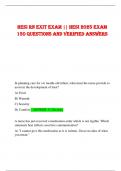
NCLEX UWORLD PHARMACOLOGY TEST BANK( ALL ANSWERS CORRECT!!)
UWorld Pharmacology The community health nurse prepares a teaching plan for a client with latent tuberculosis who is prescribed oral isoniazid (INH). Which instructions should the nurse include? Select all that apply. Unordered Options Ordered Response 1. Avoid drinking alcohol 2. Expect body fluids to change color to red 3. Report yellowing of skin or sclera 4. Report numbness and tingling of extremities 5. Take with aluminum hydroxide to prevent gastric irritation You answered this question incorrectly. Correct answer is: 1,3,4 Time Spent: 46 Seconds 38% of people answered this question correctly. Last Updated: 1/17/2016 Explanation Isoniazid (INH) is a first-line antitubercular drug prescribed as monotherapy to treat latent tuberculosis infection. Combined with other drugs, INH is also used for active tuberculosis treatment. Two serious adverse effects of INH use are hepatotoxicity and peripheral neuropathy. A teaching plan for a client prescribed INH includes the following: • Avoid intake of alcohol and limit use of other hepatotoxic agents (eg, acetaminophen) to reduce risk of hepatotoxicity (Option 1) • Take pyridoxine (vitamin B6) if prescribed to prevent neuropathy • Avoid aluminum-containing antacids (eg, aluminum hydroxide (Maalox)) within 1 hour of taking INH • Report changes in vision (eg, blurred vision, vision loss) • Report signs/symptoms of severe adverse effects such as: o Hepatoxicity (eg, scleral and skin jaundice, vomiting, dark urine, fatigue) (Option 3) o Peripheral neuropathy (eg, numbness, tingling of extremities) (Options 4) (Option 2) Rifampin, another antitubercular drug, often causes a red-orange discoloration of body fluids (ie, urine, sweat, saliva, tears). However, this effect is not associated with INH use. (Option 5) Concurrent use of antacids containing aluminum decreases INH absorption. The medication may be taken with food if gastric irritation is a concern. Educational objective: Common potential side effects of INH include hepatotoxicity (eg, jaundice, vomiting, dark urine, fatigue) and peripheral neuropathy (eg, numbness, tingling of extremities). Clients should avoid alcohol use and aluminum-containing antacids, and report any experienced side effects to the health care provider immediately. In which scenarios should the nurse hold the prescribed medication and question its administration? Select all that apply. Unordered Options Ordered Response 1. Client on IV heparin and the platelet count is 50,000/mm3 (50 x 109/L) 2. Client on newly prescribed lisinopril and is at 8 weeks gestation 3. Client on nitroglycerine patch for heart failure and blood pressure is 84/56 mm Hg 4. Client on phenytoin for epilepsy and the nurse notes gingival hyperplasia 5. Client on warfarin and prothrombin time/International Normalized Ratio is 1.5 times control value You answered this question incorrectly. Correct answer is: 1,2,3 Time Spent: 133 Seconds 30% of people answered this question correctly. Last Updated: 2/2/2016 Explanation Heparin is a natural anticoagulant. Its risk is heparin-induced thrombocytopenia (HIT), also known as heparin-associated thrombocytopenia. Normal platelet range is 150,000-400,000/mm3 (150-400 x 109/L). A mild lowering of platelets may occur and resolve spontaneously around the 4th day of administration. The danger is type II HIT, a more severe form in which there is an acute drop in the number of platelets (more than 50% from baseline), which requires discontinuing heparin (Option 1). Angiotensin-converting enzyme (ACE) inhibitors such as lisinopril are teratogenic. Lisinopril can cause embryonic/fetal developmental abnormalities (cardiovascular and central nervous system) if taken during pregnancy, especially during the first 13 weeks of gestation. During the 2nd and 3rd trimesters, ACE inhibitors interfere with fetal renal hemodynamics, resulting in low fetal urine output (oligohydramnios) and fetal growth restriction (Option 2). Nitroglycerine causes vasodilation and can lower blood pressure
Written for
- Institution
- Nursing pharmacology
- Course
- Nursing pharmacology
Document information
- Uploaded on
- November 12, 2022
- Number of pages
- 274
- Written in
- 2022/2023
- Type
- Exam (elaborations)
- Contains
- Questions & answers
Subjects
-
uworld pharmacology
-
pharm
-
the community health nurse prepares a teaching plan for a client with latent tuberculosis who is prescribed oral isoniazid inh which instructions should the nurse include