ECONOMICS 114
Chapter 1
Economic inequality and divergence
Living standard measurements
- Gross Domestic Product: measures an economy’s size
The market value of all goods produced in a country. The total income earned within
a country.
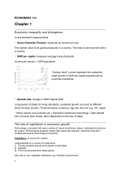
- GDP per capita: measures average living standards
income per person = GDP/population
“Hockey-stick” curves represent the sustained
rapid growth in GDP per capita experienced by
countries worldwide
- Growth rate: change in GDP/original GDP
Long period of stasis for living standards, sustained growth occurred at di erent
times for each country. Those that grew a century+ ago are now rich e.g. UK, Japan
- Africa: slavery and colonial rule + Extractive institutions (exporting) = later takeo
(not a hockey stick shape, late independence and lack of data)
The role of capitalism in economic growth
Technology: a process that uses a series of inputs (machinery, labour, materials) to produce
an output. Technological progress means less inputs are required. Industrial revolution
created permanent technological revolution.
Capitalism: an economic system
Characterised by a combo of institutions:
1) Private property (inputs and outputs of activities)
2) Markets
3) Firms (most production takes place)
Also rely on non capitalist institutions e.g. Families, Government
1
ff ff
, Economic power mainly with owners and managers, it is also limited by competition
How capitalism improved living standards:
- Specialisation: division of labour due to rms growth
Gains from specialisation is that people are more productive due to:
Economies of scale
Di erence in ability
Learning by doing (how to become better)
- Technology: Competition was incentive to innovate
Capitalism fails to raise living standards when private property isn’t secure, markets aren’t
competitive and are dominated/exploited, rms are owned by people with birth privilege
(whites in SA) or gov connections (corruption)
Absolute advantage: Country/person has it in the production of a good if the inputs used
to produce the same amount are less than the other person.
Comparative advantage: Country/person has it in the production of a good if the
opportunity costs are less than the other person.
- Greta has absolute advantage for apples and wheat (makes more with same
inputs)
- Greta has comparative advantage in wheat (1 ton wheat - 50/50 costs her
1250/50 = 25 apples) (Carlos costs 1000/20 = 50 apples per 1 ton wheat)
- Carlos has comparative advantage producing apples (1 apple costs 20/1000 =
0.02 tons wheat) (Greta costs 50/1250 = 0.04 tons of wheat for 1 apple)
2
ff fi fi
,Chapter 2
Population and income
Population hockey stick is extreme
- Sustained + dramatic increases in average income as well as medicinal advances (from
industrial revolution) removed constraint on pop growth
- Fertility and no longer mortality now constrain pop growth
- Peak pop expected in 2100
Malthusian economics
Theory: Despite the gains of technological advances, in particular income per capita rising,
nations will never be able to sustain increasing incomes per capita. He proposed that as
people’s income increases, they will have a desire to have more children as a ordability
within the household increases. Eventually population growth will outstrip resources and
living standards will decrease which will then lead to a halt in the population growth.
The Malthusian trap
- Income increase = Population increase
This leads to increase pressure on available recourses = population decrease
- This only existed until around 1800 where it was broken
Economic models
- show how interactions create equilibrium, and how it’s a ected by changes in conditions
- Models can be verbal, mathematical, graphical
Explaining stagnation
- Malthusian model uses aspects of food production
- Makes 2 assumptions:
1. Production function has a diminishing average product of labour (not exponential)
2. Population increases when the average product of labour exceeds subsistence (living)
Production functions
1. Equation 2. Table 3. Figure
Y = F(X)
3
ff ff
, - The average product diminishes because more labor is devoted to a xed quantity of
land on earth, inferior land has to be cultivated too
- Technological improvements temporarily increase the average product, but this then
increases the population until the average product falls back to subsistence levels.
3 conditions necessary to stay in the trap:
1. Diminishing average product of labour
2. Rising population in response to increase in wages
3. Absence of permanent improvements to technology (which eliminates the diminishing
average product of labour)
Industrial revolutions permanent technological improvements invalidates 3, this is how
Britain escaped the trap
The industrial revolution occurred because: economy had high wages (labour was cheaper
than coal) and labour was expensive compared to machinery
Model of innovation
Model explains how capitalism promotes technological improvements:
1. Ceteris paribus (holding things constant)
- Decision making takes all the individuals factors into account
e.g. ice cream depends on state of mind, weather etc.
- Ceteris paribus keeps all factors constant except 1 e.g. price change
2. Incentives matter
- Decision makers try to achieve the best possible outcome for themselves
- Maximising pro ts in a rm e.g. Reducing costs without e ecting revenue, we assume
they will reduce
3. Relative prices
- Ratio of its price to the price of something else
- If both prices double/quarter, relative price is constant
e.g. beer R10, burger R5, A beers relative price is 2 burgers
4. Economic rents
- Reservation option: The next best to chosen option, seen in ecos as a neutral option
always available (serves as a benchmark)
- Economic rent: The di erence between the chosen and reservation options. If you get
your rst choice beer, the extra pleasure = economic rent. If you got reservation wine,
rent = 0
- AKA “surplus”
- Possibility of earning rent creates economic incentive
- Incentives cause rational decision makers do whatever it takes to get it
- Innovation rent: Additional pro t a rm makes by choosing technology that reduces costs
- If competitors are still using old technology, price of goods remains high and so
economic rent/pro t is earned (= price × quantity sold – cost)
- Usually temporary before other rms implicate it too
4
fi fi fi fffi fi fi fi ff fi
Chapter 1
Economic inequality and divergence
Living standard measurements
- Gross Domestic Product: measures an economy’s size
The market value of all goods produced in a country. The total income earned within
a country.
- GDP per capita: measures average living standards
income per person = GDP/population
“Hockey-stick” curves represent the sustained
rapid growth in GDP per capita experienced by
countries worldwide
- Growth rate: change in GDP/original GDP
Long period of stasis for living standards, sustained growth occurred at di erent
times for each country. Those that grew a century+ ago are now rich e.g. UK, Japan
- Africa: slavery and colonial rule + Extractive institutions (exporting) = later takeo
(not a hockey stick shape, late independence and lack of data)
The role of capitalism in economic growth
Technology: a process that uses a series of inputs (machinery, labour, materials) to produce
an output. Technological progress means less inputs are required. Industrial revolution
created permanent technological revolution.
Capitalism: an economic system
Characterised by a combo of institutions:
1) Private property (inputs and outputs of activities)
2) Markets
3) Firms (most production takes place)
Also rely on non capitalist institutions e.g. Families, Government
1
ff ff
, Economic power mainly with owners and managers, it is also limited by competition
How capitalism improved living standards:
- Specialisation: division of labour due to rms growth
Gains from specialisation is that people are more productive due to:
Economies of scale
Di erence in ability
Learning by doing (how to become better)
- Technology: Competition was incentive to innovate
Capitalism fails to raise living standards when private property isn’t secure, markets aren’t
competitive and are dominated/exploited, rms are owned by people with birth privilege
(whites in SA) or gov connections (corruption)
Absolute advantage: Country/person has it in the production of a good if the inputs used
to produce the same amount are less than the other person.
Comparative advantage: Country/person has it in the production of a good if the
opportunity costs are less than the other person.
- Greta has absolute advantage for apples and wheat (makes more with same
inputs)
- Greta has comparative advantage in wheat (1 ton wheat - 50/50 costs her
1250/50 = 25 apples) (Carlos costs 1000/20 = 50 apples per 1 ton wheat)
- Carlos has comparative advantage producing apples (1 apple costs 20/1000 =
0.02 tons wheat) (Greta costs 50/1250 = 0.04 tons of wheat for 1 apple)
2
ff fi fi
,Chapter 2
Population and income
Population hockey stick is extreme
- Sustained + dramatic increases in average income as well as medicinal advances (from
industrial revolution) removed constraint on pop growth
- Fertility and no longer mortality now constrain pop growth
- Peak pop expected in 2100
Malthusian economics
Theory: Despite the gains of technological advances, in particular income per capita rising,
nations will never be able to sustain increasing incomes per capita. He proposed that as
people’s income increases, they will have a desire to have more children as a ordability
within the household increases. Eventually population growth will outstrip resources and
living standards will decrease which will then lead to a halt in the population growth.
The Malthusian trap
- Income increase = Population increase
This leads to increase pressure on available recourses = population decrease
- This only existed until around 1800 where it was broken
Economic models
- show how interactions create equilibrium, and how it’s a ected by changes in conditions
- Models can be verbal, mathematical, graphical
Explaining stagnation
- Malthusian model uses aspects of food production
- Makes 2 assumptions:
1. Production function has a diminishing average product of labour (not exponential)
2. Population increases when the average product of labour exceeds subsistence (living)
Production functions
1. Equation 2. Table 3. Figure
Y = F(X)
3
ff ff
, - The average product diminishes because more labor is devoted to a xed quantity of
land on earth, inferior land has to be cultivated too
- Technological improvements temporarily increase the average product, but this then
increases the population until the average product falls back to subsistence levels.
3 conditions necessary to stay in the trap:
1. Diminishing average product of labour
2. Rising population in response to increase in wages
3. Absence of permanent improvements to technology (which eliminates the diminishing
average product of labour)
Industrial revolutions permanent technological improvements invalidates 3, this is how
Britain escaped the trap
The industrial revolution occurred because: economy had high wages (labour was cheaper
than coal) and labour was expensive compared to machinery
Model of innovation
Model explains how capitalism promotes technological improvements:
1. Ceteris paribus (holding things constant)
- Decision making takes all the individuals factors into account
e.g. ice cream depends on state of mind, weather etc.
- Ceteris paribus keeps all factors constant except 1 e.g. price change
2. Incentives matter
- Decision makers try to achieve the best possible outcome for themselves
- Maximising pro ts in a rm e.g. Reducing costs without e ecting revenue, we assume
they will reduce
3. Relative prices
- Ratio of its price to the price of something else
- If both prices double/quarter, relative price is constant
e.g. beer R10, burger R5, A beers relative price is 2 burgers
4. Economic rents
- Reservation option: The next best to chosen option, seen in ecos as a neutral option
always available (serves as a benchmark)
- Economic rent: The di erence between the chosen and reservation options. If you get
your rst choice beer, the extra pleasure = economic rent. If you got reservation wine,
rent = 0
- AKA “surplus”
- Possibility of earning rent creates economic incentive
- Incentives cause rational decision makers do whatever it takes to get it
- Innovation rent: Additional pro t a rm makes by choosing technology that reduces costs
- If competitors are still using old technology, price of goods remains high and so
economic rent/pro t is earned (= price × quantity sold – cost)
- Usually temporary before other rms implicate it too
4
fi fi fi fffi fi fi fi ff fi