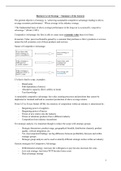
Business Level Strategy – Summary of the lectures
The general objective of strategy is: ‘achieving sustainable competitive advantage leading to above-
average economic performance’. Where average is the industry average.
“The fundamental basis of above-average performance in the long run is sustainable competitive
advantage.” (Porter, 1985)
Competitive Advantage: the firm is able to create more economic value than rival firms.
Economic Value: perceived benefits gained by a customer that purchases a firm’s products or services
minus the full economic cost of these products and services.
Nature of Competitive Advantage:
CA that is hard to copy, examples:
- Brand name
- Path dependency (history)
- Absorptive capacity (firm’s ability to learn)
- Tacit knowledge
A sustainable competitive advantage: has value creating processes and positions that cannot be
duplicated or imitated and lead to consistent production of above average returns.
Porter’s Five Forces Model (FFM): the intensity of competition within an industry is determined by:
- Bargaining power of suppliers
- Bargaining power of buyers
- Threat of new entries into the industry
- Threat of substitute products from a different industry
- Competition from industry incumbents
For strategic analysis it is important though to reduce the scope with strategic groups:
- Strategic dimensions: product range, geographical breadth, distribution channels, product
quality, vertical integration, etc.
- Yet, most empirical findings: not big difference between profitability between and within
strategic groups
- Strategic group analysis can be used to identify different strategic niches within an industry
Generic strategies for Competitive Advantage:
- Differentiation strategy: increases the willingness to pay but also increases the costs
- Low-cost strategy: has lower WTP but also lower costs
- Dual advantage strategy
1
, If performance is determined by industry, all firms in the same industry should perform similarly? Do
differences between firms matter?
M. Porter (1979): Attractive industry + favorable competitive positioning → superior profitability
- Locate within attractive industries
- Adopt strategies that modify industry conditions and competitor behavior to moderate
competition
But: J. Barney (1991): Resources and capabilities of a firm may be more reliable sources of
competitive advantage than market focus.
The potential of resources and capabilities to earn profit, three factors:
- Ability to establish a Competitive Advantage
- Ability to sustain that Competitive Advantage
- Ability to appropriate the returns from that Competitive Advantage
Establishing a competitive advantage:
- Scarcity
Resource which is essential to compete, but widely available in the industry – not a
sufficient basis for CA.
- Relevance
Resource or capability must assist in creating value for customers, or surviving
competition.
Sustaining a competitive advantage, depends on:
- Durability of resources and capabilities
Short durability: capital equipment and proprietary technologies
Long durability: reputation
- Whether rivals can imitate the CA that these resources and capabilities offer: transfer or
replicate
Easily transferable: finance, raw materials, components, skilled employees
Immobile: geographical immobility of natural resources, large items of capital
equipment; complementarity between resources; organizational capabilities are less
mobile than resources
Easily replicable: financial innovations, CA in retailing (store layout, extended
opening hours, design)
Difficult to replicate: capabilities based on complex organizational routines, e.g.
FedEx national, next-day delivery service; just-in-time scheduling and quality
services by Japanese companies
2
The general objective of strategy is: ‘achieving sustainable competitive advantage leading to above-
average economic performance’. Where average is the industry average.
“The fundamental basis of above-average performance in the long run is sustainable competitive
advantage.” (Porter, 1985)
Competitive Advantage: the firm is able to create more economic value than rival firms.
Economic Value: perceived benefits gained by a customer that purchases a firm’s products or services
minus the full economic cost of these products and services.
Nature of Competitive Advantage:
CA that is hard to copy, examples:
- Brand name
- Path dependency (history)
- Absorptive capacity (firm’s ability to learn)
- Tacit knowledge
A sustainable competitive advantage: has value creating processes and positions that cannot be
duplicated or imitated and lead to consistent production of above average returns.
Porter’s Five Forces Model (FFM): the intensity of competition within an industry is determined by:
- Bargaining power of suppliers
- Bargaining power of buyers
- Threat of new entries into the industry
- Threat of substitute products from a different industry
- Competition from industry incumbents
For strategic analysis it is important though to reduce the scope with strategic groups:
- Strategic dimensions: product range, geographical breadth, distribution channels, product
quality, vertical integration, etc.
- Yet, most empirical findings: not big difference between profitability between and within
strategic groups
- Strategic group analysis can be used to identify different strategic niches within an industry
Generic strategies for Competitive Advantage:
- Differentiation strategy: increases the willingness to pay but also increases the costs
- Low-cost strategy: has lower WTP but also lower costs
- Dual advantage strategy
1
, If performance is determined by industry, all firms in the same industry should perform similarly? Do
differences between firms matter?
M. Porter (1979): Attractive industry + favorable competitive positioning → superior profitability
- Locate within attractive industries
- Adopt strategies that modify industry conditions and competitor behavior to moderate
competition
But: J. Barney (1991): Resources and capabilities of a firm may be more reliable sources of
competitive advantage than market focus.
The potential of resources and capabilities to earn profit, three factors:
- Ability to establish a Competitive Advantage
- Ability to sustain that Competitive Advantage
- Ability to appropriate the returns from that Competitive Advantage
Establishing a competitive advantage:
- Scarcity
Resource which is essential to compete, but widely available in the industry – not a
sufficient basis for CA.
- Relevance
Resource or capability must assist in creating value for customers, or surviving
competition.
Sustaining a competitive advantage, depends on:
- Durability of resources and capabilities
Short durability: capital equipment and proprietary technologies
Long durability: reputation
- Whether rivals can imitate the CA that these resources and capabilities offer: transfer or
replicate
Easily transferable: finance, raw materials, components, skilled employees
Immobile: geographical immobility of natural resources, large items of capital
equipment; complementarity between resources; organizational capabilities are less
mobile than resources
Easily replicable: financial innovations, CA in retailing (store layout, extended
opening hours, design)
Difficult to replicate: capabilities based on complex organizational routines, e.g.
FedEx national, next-day delivery service; just-in-time scheduling and quality
services by Japanese companies
2